
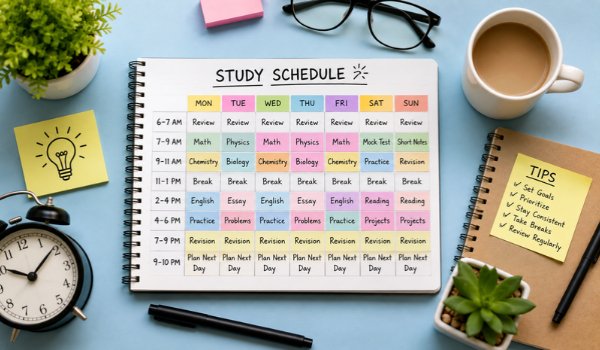
You’ve probably made a study schedule before. Color-coded, maybe even laminated in your head if not on paper. And by Wednesday, it was already dead.
That’s not because you’re bad at planning. Most study schedules fail because they’re built wrong from the start — too packed, too rigid, too disconnected from how your actual week goes. A good one works with your life, not against it. Here’s how to build one that survives past day two.
Why Most Study Schedules Fall Apart
Here’s the pattern. You sit down, feeling motivated, and block out every hour from 4 PM to 10 PM with a subject. It looks great on paper.
Then real life happens. Practice runs late. A friend calls. You’re just tired. One missed block turns into “well, the whole schedule’s ruined now,” and you scrap it entirely.
The problem isn’t you. It’s that a schedule with zero flexibility only works if literally nothing unexpected happens — which, let’s be honest, never happens for very long.
How Do I Make a Study Schedule That Actually Works?
Start smaller than you think you need to. A schedule that’s 70% realistic beats one that’s 100% perfect on paper and 0% followed in real life.
Here’s a simple process that actually holds up:
- List everything you need to study, subject by subject, topic by topic
- Rank each topic by how comfortable you are with it — strong, okay, weak
- Give weak topics more time, not equal time across the board
- Pick your actual free hours, based on your real week, not your ideal one
- Assign subjects to specific blocks, but keep the blocks shorter than you’d expect
- Build in buffer time, at least one flexible slot a week, for the stuff that runs over
This isn’t about mapping out every minute. It’s about knowing what you’re doing and when, without needing to be a robot to follow it.
How Many Hours a Day Should a Study Schedule Include?
There’s no perfect number that fits everyone. It depends on your workload, how close exams are, and how you personally focus.
That said, a few things tend to hold true across the board:
- Shorter, focused blocks beat long, foggy ones — 25 to 50 minutes per block is a solid range
- Two or three focused hours a day usually beats five distracted ones
- Exam weeks naturally need more time than a normal school week
- If you’re consistently exhausted, the schedule has too much in it, not too little
A realistic target for most students is somewhere around two to four solid hours a day outside class, adjusted up as tests get closer. The number matters less than whether you can actually hit it, day after day.

Weekly vs. Daily — Which Schedule Actually Works Better
Both have a place, honestly. It depends on how your brain likes to plan.
A weekly schedule works well if you like flexibility. You set weekly goals (say, finish two chapters of biology, review your history notes twice) and choose which day to tackle each one, based on how your week actually unfolds.
A daily schedule works better if you need more structure to actually sit down and start. You know exactly what block comes next, which removes the “what should I even work on” hesitation.
A lot of students end up doing both — weekly goals broken into daily to-do lists. That combo tends to hold up the longest, since it has both direction and flexibility built in.
How to Fit Studying Around a Busy Schedule
If you’ve got school, a job, sports, or family stuff eating your time, a packed hour-by-hour plan just isn’t realistic. So don’t build one.
Instead:
- Find your actual open windows — even 20-30 minutes between activities counts
- Use small pockets of time for quick review, like flashcards on the bus or between classes
- Protect one or two solid blocks a week for deeper, focused study
- Say no to a rigid daily plan. A flexible weekly goal fits a busy life far better
Studying doesn’t require huge chunks of free time. It requires consistent chunks, even small ones, used well.
Don’t Skip the Breaks — They’re Part of the Schedule
A lot of students leave breaks out of their schedule entirely, like they’re optional or a waste of time. They’re not. They’re part of what makes the studying stick.
Focus naturally fades after sustained effort. Working straight through that dip usually just means low-quality studying, not extra progress.
A simple rhythm to build in:
- Study for 25–45 minutes, fully focused
- Take a 5–10 minute break, away from your phone if possible
- Repeat for a few rounds
- Take a longer break, 20-30 minutes, after two or three rounds
Put these breaks directly into your schedule, not as an afterthought. That way they don’t quietly turn into an hour of scrolling that eats the next block too.
What to Do If You Fall Behind on Your Study Schedule
You will fall behind at some point. Everyone does. What matters is how you handle it.
- Don’t scrap the whole schedule. One missed block doesn’t ruin the plan, it just needs a small adjustment
- Reassess, don’t panic. Look at what’s left and re-prioritize based on what’s actually most important now
- Cut, don’t cram. If you’re behind, trim lower-priority topics instead of trying to squeeze everything into less time
- Rebuild from today, not from the original plan. The old schedule is gone. Build the next few days fresh.
A schedule you keep adjusting is way more useful than a perfect one you abandon the first time it breaks.
Adjusting Your Schedule As Exams Get Closer
Your schedule shouldn’t stay the same the entire term. As exams approach, it needs to shift from “learning new material” to “reviewing and locking it in.”
A few changes worth making in the final couple weeks:
- Shift more blocks toward review and practice questions, not new content
- Increase how often you revisit older topics, not just recent ones
- Add in memory-focused sessions for anything you need to recall quickly, like dates, formulas, or vocab
- Start winding down late-night sessions, since sleep matters more the closer you get to test day
If you want more on the technique side of this shift, our guides on studying effectively for exams and memorizing faster go deeper into exactly how to use this review time well.
Closing Thoughts
A study schedule doesn’t need to be perfect. It needs to be realistic enough that you’ll actually follow it, and flexible enough to survive contact with your actual life.
Start with something small this week. Build from there, and adjust as you go. For more on the study methods that fill in those blocks once your schedule’s set, check out our full guide on study techniques for students.
