

You know that feeling when class moves too fast one day and painfully slow the next? Like the teacher’s either racing through a topic you’re still lost on, or dragging out something you already get?
That mismatch is basically the whole reason personalized learning exists.
It’s a term you’ve probably heard tossed around a lot lately — in school announcements, on ed-tech ads, maybe even from a teacher trying to sound cutting-edge. But what does it actually mean once you strip away the buzzword?
What Personalized Learning Actually Means
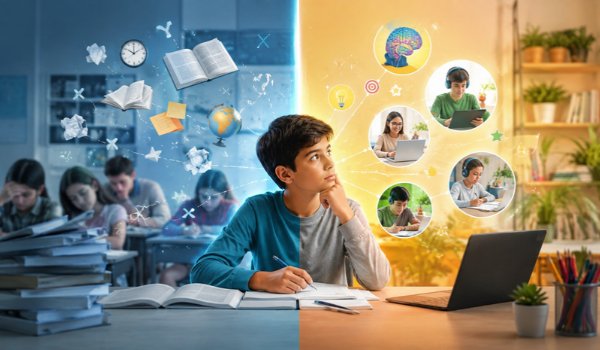
Here’s the simplest way to put it: personalized learning means your education bends around you, instead of you having to bend around it.
Not every student learns the same way, at the same speed, or for the same reasons. So instead of handing everyone the identical lesson and hoping it lands, this approach adjusts based on where you actually are.
Say you’re solid at algebra but geometry makes your brain hurt. A personalized setup won’t waste your time re-teaching algebra basics you’ve already nailed. It’ll push more time and support toward geometry, where you actually need it.
It’s less a single method and more of a philosophy — one that shapes how lessons, feedback, and even deadlines get built around real students instead of an imaginary “average” one.
Why Traditional Classrooms Struggle With This
Old-school classrooms were basically designed for a student who doesn’t exist: the perfectly average kid who learns at a perfectly average pace.
Except nobody’s actually average. Some people pick up new concepts almost instantly. Others need three explanations, a diagram, and a good night’s sleep before it clicks. Both are completely normal.
In a traditional class, though, everyone gets the same pace, same homework, same test, same deadline — regardless of what’s actually going on in their brain that week.
Personalized learning asks a different question. Not “what’s next on the syllabus,” but “what does this specific student need right now?”
Sometimes that means one kid gets extra practice problems while another gets handed a harder project — same classroom, same day, totally different experience.
Where AI and Tech Actually Fit In
You can’t really talk about personalized learning anymore without mentioning technology. It’s become the backbone of how a lot of this works in practice.
Adaptive learning platforms watch how you answer questions in real time. Crushing it? They speed up. Struggling? They slow down and throw more support your way before moving on.
AI has pushed this further just in the last couple of years. Some AI tutoring tools will explain the same concept five different ways until one of them finally makes sense — patiently, without judging you for asking twice. They’re also surprisingly good at spotting patterns, like noticing you keep messing up the exact same type of word problem, something a teacher juggling thirty other students might not catch as fast.
None of this replaces a teacher, by the way. Think of it more like a study partner who never gets tired and never rolls their eyes.
Does Personalized Learning Actually Work?
Fair question. And the honest answer is: it depends how it’s done.
Done well, students generally end up more engaged. That tracks — lessons that actually match your pace and interests are just more motivating than a stack of generic worksheets.
It also tends to cut down on that specific misery of being either bored out of your mind (too easy) or completely lost (too fast). Neither of those states is great for actually learning anything.
But it’s not some magic fix. It still takes effort. Good tools help, but they don’t do the learning for you.
What This Looks Like in Real Life
Talking about this in the abstract only goes so far, so here’s what it tends to look like in practice:
- Adaptive quizzes that shift difficulty based on how you’re doing
- More flexible deadlines for students who need extra time to process
- Choice-based assignments — pick the project format that actually suits how you think
- AI tutors walking you through a tricky concept at your own pace
- Skill-tracking that looks past just a letter grade
If you’ve ever used a reading app that quietly adjusts vocabulary difficulty as you go, congratulations — you’ve already experienced personalized learning without realizing it. It ties in closely with reading skills specifically. If that’s something you want to dig into further, this guide on improving reading comprehension is worth a read.
The Part Nobody Really Talks About
Personalized learning sounds great in theory. In practice, it’s a bit messier.
For one, it takes way more work to set up than people assume. Teachers need time — and usually training — to build flexible lessons instead of one standard version for everyone.
There’s also an access problem. Not every school can afford the adaptive tools that make this easier, which creates a real gap between schools that have the tech and schools that don’t.
And honestly, this last one’s on students too. Personalized learning only works if you actually engage with it. More freedom sounds nice, but it comes with more responsibility. Ignore the extra support or skip the flexible options, and none of this helps much.
So no, it’s not a cure-all. It’s a tool. Like most tools, it’s only as good as how you use it.
How to Start Personalizing Your Own Learning
Even if your school doesn’t have some fancy adaptive system, you can start doing this yourself. Right now, honestly.
Pay attention to how you actually learn. Do things stick better when you read them, hear them, or physically do them? Spend a week noticing this instead of guessing.
Look for tools that adjust to you. Doesn’t have to be expensive software — even a free flashcard app using spaced repetition counts.
Set small, specific goals. Skip the vague “study for the test.” Try something like “understand these three topics by Thursday.” Way easier to track, way easier to actually finish.
Where Education Seems to Be Headed
The direction is pretty clear at this point: away from “one path for everyone.”
Expect more AI-assisted tutoring, more flexible pacing, and a bigger shift toward measuring actual skills instead of just grades. Competency-based learning — where you move on once you’ve genuinely mastered something, not just when the semester ends — is picking up steam too.
Blended learning, mixing in-person classes with online tools, has basically become the default rather than something unusual.
If there’s one big theme here, it’s this: education is starting to care more about how you learn, not just what number ends up on your report card.
Why This Matters Beyond Just This Semester
Here’s something worth sitting with for a second: how you learn now quietly shapes decisions you’ll be making later.
Students who actually understand their own learning style tend to feel more confident about bigger education choices down the line — including things like whether to go for a bachelor’s degree or push further into a master’s. If that’s a decision that’s somewhere on your radar already, this breakdown comparing a bachelor’s degree vs a master’s degree is a useful read.
Personalized learning isn’t just about surviving this semester. It’s building habits that make the next big decision a little less overwhelming.
Final Thoughts
Personalized learning isn’t some passing trend. It’s quickly becoming just how education works.
The good part? You don’t have to wait around for your school to catch up. You can start applying this stuff today — pay attention to how you learn, use tools that adapt to you, and set goals that actually fit your pace.
Want more practical study tips built around how students actually learn, minus the fluff? There’s more of that over on Trafily.
