
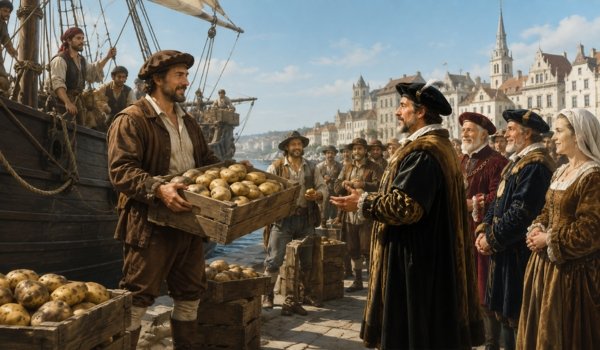
Potatoes arrived in Europe in the second half of the 16th century, following Spanish colonization of South America. Spanish conquistadors first encountered the crop in the Andes around 1532–1535. By 1570, potatoes had reached Spain, and over the next century, the crop spread across the continent—eventually transforming European agriculture, population growth, and cuisine.
Few foods have shaped human history as quietly—or as profoundly—as the potato. Long before it became a staple of European kitchens, it was growing in the high-altitude regions of the Andes, cultivated by Indigenous peoples who had domesticated it over thousands of years. Its arrival in Europe was not a single dramatic moment but a gradual, often misunderstood process that unfolded over decades.
Understanding when and how potatoes came to Europe means tracing one of history’s most consequential food transfers. It’s a story of exploration, skepticism, slow adoption, and eventually, revolutionary change. By the 18th century, a crop that Europeans had once eyed with suspicion had become the foundation of the continent’s food supply—feeding armies, sustaining peasant families, and fueling population booms across Ireland, Germany, and beyond.
This article walks through the full history: where potatoes came from, how they reached European shores, why it took so long for the continent to embrace them, and what their adoption ultimately meant for the modern world.
Where Did Potatoes Originally Come From, and Who First Cultivated Them?
The potato (Solanum tuberosum) is native to the Andean highlands of South America, with origins tracing back to what is now southern Peru and northwestern Bolivia. Archaeological evidence suggests that Indigenous Andean communities—including the Inca—had been cultivating potatoes for at least 7,000 to 10,000 years before European contact. According to the International Potato Center (CIP), the wild ancestors of the modern potato were first domesticated in the region around Lake Titicaca, which sits on the border of present-day Peru and Bolivia (International Potato Center, cip.cgiar.org).
Andean farmers developed hundreds of distinct potato varieties suited to different altitudes and climates. They also pioneered a preservation technique called chuño—freeze-drying potatoes using cold mountain nights and dry daytime air—which allowed the crop to be stored for years. This made the potato not just a food source but a strategic resource across the Inca Empire.
When Spanish conquistadors arrived in South America in the early 16th century, they encountered a food system built significantly around this versatile tuber. The first documented European sighting of the potato is generally attributed to Spanish explorers in the Andean region of present-day Peru around 1532–1535, during Francisco Pizarro’s conquest of the Inca Empire.
When Did Potatoes First Arrive in Spain and Europe, Around the 1560s to 1570s?
The exact date of the potato’s arrival in Europe remains a subject of historical debate, but the most widely accepted evidence points to the late 1560s. Spanish ships returning from the Americas carried potato specimens to Spain, where the earliest recorded reference to the crop dates to 1567. A document from that year describes potatoes being shipped from the Canary Islands to Antwerp.
By 1570, the potato was being cultivated in Spain itself. According to historical records cited by the Royal Botanical Garden of Spain, the Hospital de la Sangre in Seville was purchasing potatoes as food for patients as early as 1573—making it one of the first documented uses of potatoes in European history. This suggests that within a few years of their arrival, potatoes were already being grown and traded within Spain, even if they hadn’t yet captured mainstream attention (Real Jardín Botánico, CSIC, rjb.csic.es).
From Spain, the crop spread—slowly—to Italy, the Netherlands, and other parts of western Europe in the latter decades of the 16th century. By the early 1600s, potatoes had reached England, Ireland, Germany, and France, though widespread cultivation remained limited. The plant was still largely a curiosity: grown in botanical gardens, studied by herbalists, and regarded with a mixture of fascination and distrust by the general public.
Why Were Europeans So Reluctant to Eat Potatoes After Their Arrival?
The slow adoption of potatoes across Europe is one of history’s more puzzling food stories. Despite being nutritious, easy to grow, and productive on small plots of land, the potato faced nearly two centuries of widespread skepticism before becoming a dietary staple.
Several factors contributed to this resistance. First, the potato belongs to the Solanaceae family—the same botanical family as deadly nightshade, a toxic plant well known in Europe. Many Europeans were understandably wary of a plant that looked similar to something poisonous. The potato’s above-ground berries, which are indeed toxic, reinforced these fears.
Second, there was a theological dimension to the suspicion. Because potatoes are not mentioned in the Bible, some religious communities treated the crop as suspect. In certain parts of Europe, potatoes were even associated with the devil, and clergy reportedly discouraged their consumption.
Third, early potato varieties introduced to Europe were often bitter or poorly suited to lower-altitude European climates. Without proper cultivation knowledge, early harvests may have been unimpressive, giving the crop a reputation for unreliability.
Class prejudice also played a role. In France and parts of Germany, potatoes were initially used as animal fodder, which made them socially undesirable as human food. Eating a crop associated with livestock was considered beneath the dignity of many farmers and townspeople, even those who were struggling economically.
How Did Potatoes Finally Become Widely Accepted Across Europe in the 18th Century?
The turning point came in the 18th century, driven by a combination of famine, royal promotion, and agricultural pragmatism.
Frederick the Great of Prussia played a pivotal role in popularizing the potato in the German states. Recognizing the crop’s potential to feed his growing population and sustain military campaigns, he issued royal decrees in the 1740s mandating potato cultivation. When farmers resisted, he reportedly deployed a clever tactic: posting royal guards around potato fields to suggest the crop was too valuable for ordinary people, thereby sparking curiosity and desire. Whether or not this story is fully accurate, Frederick’s agricultural campaigns did dramatically increase potato cultivation in Prussia.
In France, a pharmacist and agronomist named Antoine-Augustin Parmentier became the potato’s most famous advocate. After subsisting on potatoes as a prisoner of war in Prussia, Parmentier returned to France convinced of their potential. He organized banquets featuring potato dishes for French nobility—reportedly serving them to Benjamin Franklin and Antoine Lavoisier—and lobbied King Louis XVI to endorse the crop. His efforts were successful: by the late 18th century, the French government had lifted restrictions on potato cultivation, and the crop began spreading more rapidly across the country. Today, the French word for potato dishes often bears his name: parmentier.
In Ireland, the potato had already become a dietary cornerstone by the mid-17th century, adopted rapidly because of its high caloric yield per acre and its suitability for Irish soil and climate. Irish peasants, who often lacked access to larger plots of land, found that a small potato garden could sustain an entire family. By the 18th century, potatoes accounted for a significant portion of the Irish diet—a dependence that would carry devastating consequences when the Great Famine struck in 1845.
What Was the Long-Term Impact of Potatoes on European Population Growth and Agriculture?
The nutritional and agricultural impact of the potato on Europe was extraordinary. A 2011 study published in the American Economic Review by economists Nathan Nunn and Nancy Qian analyzed the relationship between the introduction of the potato and European population growth. Their findings suggested that the adoption of the potato accounts for a significant share of the population increase in Europe between 1700 and 1900—an era that saw the continent’s population roughly triple (Nunn & Qian, American Economic Review, 2011).
The reasons are straightforward. A single acre of potatoes produces more calories than an acre of most grain crops. The potato also contains a broad spectrum of essential nutrients—vitamin C, potassium, vitamin B6, and iron—making it one of the most complete single-food sources available to a subsistence farmer. Replacing a portion of grain-based agriculture with potato cultivation freed up land, reduced famine risk, and enabled more people to survive harsh winters.
The potato also influenced military history. Armies that could feed soldiers on a compact, storable, calorie-dense food had a logistical advantage, and several European military powers—including Prussia and Russia—leveraged potato cultivation for exactly this purpose.
How Did the Irish Potato Famine of 1845 Reveal the Risks of Over-Reliance on a Single Crop?
No discussion of potatoes in Europe is complete without acknowledging the catastrophic failure that came from over-dependence on a single variety. The Irish Potato Famine (1845–1852), known in Ireland as An Gorta Mór (The Great Hunger), was triggered by a water mold called Phytophthora infestans, which destroyed successive potato harvests.
By the 1840s, approximately one-third of Ireland’s population—predominantly the rural poor—depended almost entirely on a single potato variety, the Irish Lumper. When blight struck, there was no backup crop to fall back on. The consequences were devastating: approximately one million people died of starvation and disease, and another million or more emigrated in the immediate years that followed, according to historical estimates compiled by the USDA Economic Research Service (USDA ERS, ers.usda.gov).
The famine permanently altered Ireland’s demographic landscape and remains one of the defining events in Irish history. It also became a defining case study in agricultural economics, illustrating the systemic risks of monoculture farming—a lesson that continues to shape crop science and food policy today.
What Role Do Potatoes Play in European Agriculture and Cuisine in 2026?
Potatoes remain one of the most important crops in Europe. According to Eurostat data, the European Union produces over 40 million tonnes of potatoes annually, with Germany, France, the Netherlands, and Poland among the leading producers. The crop supports extensive food processing industries, from frozen fries to potato starch used in paper and textile manufacturing.
Culturally, potatoes are embedded in the culinary identities of dozens of European nations. From the Kartoffelsalat of Germany to Ireland’s colcannon, from France’s gratin dauphinois to Poland’s kopytka, the potato has proven extraordinarily adaptable to regional flavors and cooking traditions.
Modern potato research continues to evolve, with breeders developing disease-resistant, climate-adapted varieties suited to changing growing conditions across Europe. The International Potato Center coordinates global efforts to preserve genetic diversity among thousands of potato varieties—a direct acknowledgment that the monoculture failures of the 19th century must not be repeated.
Final Thoughts: Why the History of the Potato Still Matters Today
The potato’s journey from the Andean highlands to the tables of Europe is a story about more than food. It reflects how agricultural exchange between civilizations can reshape economies, populations, and cultures on a generational scale. The reluctance of early European farmers to adopt the potato—and the eventual, dramatic consequences when they did—offers a lens through which to understand food security, crop dependency, and the importance of biodiversity.
For anyone studying food history, agricultural policy, or the broader effects of globalization, the potato’s European history is an essential chapter. The next time you reach for a bag of potatoes, you’re holding the result of thousands of years of Andean cultivation, centuries of transatlantic trade, and decades of hard-won agricultural acceptance—a legacy worth understanding.
Frequently Asked Questions About Potatoes and Their History in Europe
When exactly did potatoes arrive in Europe?
Potatoes are believed to have arrived in Europe in the late 1560s, with the first documented evidence pointing to 1567. By 1570, the crop was being cultivated in Spain. From there, it spread to Italy, England, Ireland, and Germany over the following decades.
Who brought potatoes to Europe?
Spanish conquistadors are credited with bringing potatoes to Europe following their contact with Andean civilizations in South America in the 1530s. The crop traveled to Spain via trade routes connecting the Americas, the Canary Islands, and the Iberian Peninsula.
Why did it take so long for Europeans to accept potatoes?
Europeans were slow to adopt potatoes due to a mix of botanical suspicion (the plant belongs to the nightshade family), lack of biblical mention, early variety shortcomings, and social stigma around a crop associated with animal feed. Widespread acceptance didn’t come until the 18th century.
Which European country adopted potatoes first?
Spain was the first European country to cultivate potatoes, with documented records of potato use dating to the early 1570s. Ireland became one of the earliest adopters among northern European nations, with potatoes forming a central part of the rural diet by the mid-17th century.
What was the impact of potatoes on European population growth?
Research by economists Nathan Nunn and Nancy Qian, published in the American Economic Review (2011), found that potato adoption contributed significantly to European population growth between 1700 and 1900, largely due to the crop’s high caloric yield and nutritional value relative to traditional grain crops.
What caused the Irish Potato Famine?
The Irish Potato Famine (1845–1852) was caused by the water mold Phytophthora infestans, which devastated Ireland’s potato crops over several consecutive years. Because rural Irish communities depended almost entirely on a single potato variety, there was no alternative food source when the blight struck, resulting in widespread famine, death, and emigration.
