
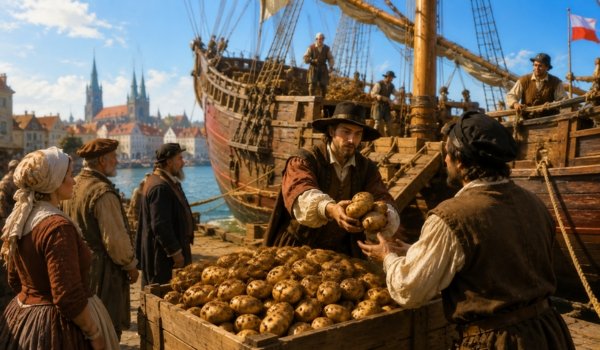
Potatoes arrived in Poland in the late 17th century, most likely introduced during the reign of King John III Sobieski (around 1683). Initially grown as a curiosity in noble gardens, potatoes became a staple crop across the Polish countryside by the mid-18th century, fundamentally reshaping the country’s diet, agriculture, and population growth.
Few foods have shaped a nation’s identity as quietly—or as profoundly—as the potato has shaped Poland’s. Today, Poland ranks among the top potato-consuming countries in Europe, with the crop appearing in everything from pierogi to żurek. Yet for centuries, the potato didn’t exist on Polish soil at all. Its arrival was slow, contested, and far more fascinating than most history books let on.
This post traces the full story of how the potato came to Poland: from its origins in the Andes to its reluctant adoption by Polish peasants, and ultimately its transformation into a cultural cornerstone. Along the way, we’ll look at the historical forces that drove its spread, the people who championed it, and what its legacy means for Polish food culture today.
Where Did Potatoes Come From Before They Reached Poland?
Before potatoes could arrive in Poland, they had to cross an ocean. The potato (Solanum tuberosum) was first cultivated by Indigenous peoples in the Andes mountains of South America—particularly in present-day Peru and Bolivia—as far back as 8,000 years ago. Spanish conquistadors encountered the crop during their colonization of South America in the 16th century and brought it back to Europe around 1570.
From Spain, the potato spread gradually across Europe. It reached Italy, then moved north through the Netherlands, Germany, and France. Each country met it with varying degrees of enthusiasm and suspicion. The plant belonged to the nightshade family, which made many Europeans wary—poisonous plants like belladonna shared the same botanical lineage, and that association was hard to shake.
By the time the potato reached Central and Eastern Europe in the late 1600s, it had already spent nearly a century proving its value in Western Europe. But Poland’s relationship with the crop would develop along its own distinct timeline.
When Did the Potato First Arrive in Poland, and Who Brought It?
The most widely cited account places the potato’s arrival in Poland around 1683, during the reign of King John III Sobieski. According to historical tradition, Sobieski brought potato specimens back to Poland after his famous victory at the Battle of Vienna—a pivotal moment in which Polish-led forces repelled the Ottoman siege of the Habsburg capital. The story goes that he introduced the plant to his gardens in Warsaw as a botanical curiosity, having encountered it during his military campaign through Central Europe.
However, historians note that the precise origins of the potato in Poland are difficult to pin down with absolute certainty. Some sources suggest that earlier introductions may have occurred through trade routes or noble exchanges in the mid-17th century. What is well-documented is that by the 1680s and 1690s, potatoes were being cultivated in the gardens of Polish aristocrats and royal estates, though they were grown primarily as decorative or novelty plants rather than food.
According to the Polish Academy of Sciences, written records of potato cultivation in Poland become more frequent and detailed from the 1730s onward, as the crop began its transition from garden curiosity to agricultural commodity.
Why Did It Take So Long for Potatoes to Become a Polish Staple?
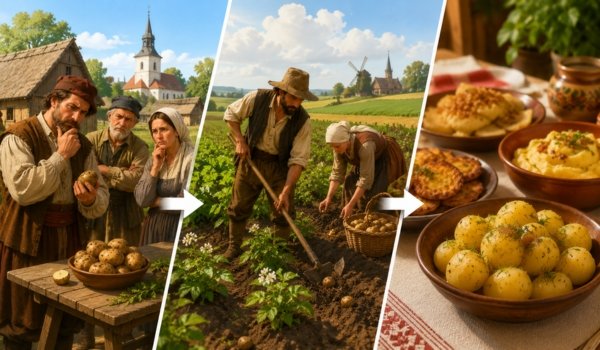
The gap between the potato’s arrival and its widespread adoption is one of the more intriguing chapters in Polish agricultural history. For several decades after its introduction, the potato struggled to gain traction among the general population—and the reasons were both cultural and practical.
Peasants across Central Europe were deeply skeptical of the unfamiliar tuber. Many believed it caused disease. Others objected on religious grounds, arguing that since the potato was not mentioned in the Bible, it was suspect. The plant’s above-ground berries were toxic, and without clear guidance on how to eat the root, early encounters with the crop could literally be dangerous.
Polish nobility, who had the most access to new botanical introductions, viewed the potato as a foreign oddity rather than a potential food source. It took deliberate, top-down intervention to change that perception.
The turning point came in the mid-18th century, particularly during the reign of Augustus III and later under Stanisław August Poniatowski, Poland’s last king. During this period, agricultural reformers—inspired by Enlightenment ideas about science, productivity, and the public good—began actively promoting potato cultivation as a solution to recurring food shortages. Landowners were encouraged to grow potatoes on their estates, and in some regions, peasants were instructed or incentivized to plant them.
The logic was straightforward: potatoes produced more calories per acre than rye or wheat, survived in poor soil conditions, and could be harvested quickly. During the devastating famines that periodically swept through 18th-century Europe, that argument became impossible to ignore.
How Did Potatoes Spread Across the Polish Countryside in the 18th Century?
The mass adoption of potatoes in Poland unfolded over the course of several decades during the 1700s, driven by a combination of agrarian reform, population pressure, and necessity. As estates began growing potatoes at scale, the crop gradually made its way into peasant gardens and village plots.
Regional variation played a significant role. Potatoes spread faster in areas with poor, sandy soils—such as Mazovia and parts of Greater Poland—where traditional grain crops struggled. In more fertile regions, adoption was slower, as farmers were less motivated to switch from established staples like rye.
The partitions of Poland, which divided the country among Russia, Prussia, and Austria between 1772 and 1795, also had an unexpected agricultural effect. Prussian administrators, who had already overseen Prussia’s famous “potato revolution” under Frederick the Great, actively promoted potato cultivation in the territories they controlled. Frederick the Great had famously forced Prussian peasants to grow potatoes starting in 1744, and that policy extended into Prussian-controlled Polish lands after partition.
By the early 19th century, potatoes had become firmly embedded in the Polish diet—particularly among the rural working class. They were boiled, mashed, added to soups, and combined with dough to produce the kinds of dishes that would eventually define Polish cuisine on the world stage.
What Role Did the Potato Play in Shaping Polish Food Culture and Demographics?
The potato’s impact on Poland extended well beyond the kitchen. Historians of European agriculture, including those cited by the Food and Agriculture Organization of the United Nations (FAO), have linked the widespread adoption of the potato across 18th- and 19th-century Europe to significant population growth. The crop’s caloric density and reliability helped buffer against the worst famines, allowing more people to survive harsh winters and crop failures.
In Poland, this demographic effect was particularly pronounced in rural areas. As the potato became a dietary staple, caloric security improved for peasant families who had previously depended on grain harvests susceptible to weather and disease.
Culturally, the potato wove itself into the fabric of Polish cooking with remarkable speed. Dishes like kopytka (potato dumplings), placki ziemniaczane (potato pancakes), and the potato-filled variants of pierogi all emerged or evolved during the 18th and 19th centuries. The potato even found its way into Polish folk traditions and regional identity—certain regions became known for specific potato-based dishes that remain points of local pride today.
According to Eurostat data, Poland remains one of Europe’s leading potato producers and consumers in the 21st century, with annual production consistently exceeding 6 million metric tons in recent years.
How Does Poland’s Potato History Compare to Other European Countries?
Poland’s experience with the potato follows a broadly similar arc to other Central and Eastern European nations, though the specific timing and mechanisms of adoption varied. Germany’s adoption was more forcibly state-driven, thanks to Frederick the Great’s edicts. Ireland’s dependence on the potato developed earlier and more intensely, culminating in the catastrophic Great Famine of 1845–1852 when the potato crop failed.
France’s adoption famously involved Antoine-Augustin Parmentier, an agronomist who championed the potato after surviving on them as a prisoner of war in Prussia. His campaign to popularize potatoes in France in the 1770s and 1780s offers an interesting parallel to similar Enlightenment-era campaigns in Poland.
What distinguishes Poland’s story is the layered complexity of its political situation. The partitions meant that Polish agricultural development was shaped by three different foreign powers simultaneously, each with their own policies toward potato cultivation. This fragmentation made national-level adoption slower and more uneven—but also contributed to the rich regional diversity of Polish potato-based cuisine that persists to this day.
What Can Poland’s Potato History Teach Us About Food Adoption and Agricultural Change?
The story of the potato in Poland is ultimately a story about how new foods enter cultures—and the forces that accelerate or resist that process. Cultural skepticism, religious tradition, agrarian inertia, and political fragmentation all slowed the potato’s adoption. Yet economic necessity, Enlightenment-era reform, and the sheer practicality of a calorie-dense, adaptable crop eventually won out.
This history has relevance beyond food. It illustrates how even highly beneficial innovations can take generations to become mainstream, and how top-down policy intervention sometimes plays a decisive role in overcoming grassroots resistance. For agricultural historians, development economists, and food scholars, the potato’s journey through Poland offers a textbook case study in technology diffusion and dietary change.
It also serves as a reminder that the foods most deeply associated with national identity are rarely ancient. The potato has been central to Polish cuisine for roughly 250 years—a blink of an eye in the span of human history. What feels timeless is often surprisingly recent.
Final Thoughts: A Small Tuber With a Large Legacy
The potato’s arrival in Poland—tentative, contested, and initially confined to noble gardens—eventually produced one of the most durable transformations in the country’s agricultural and culinary history. From King John III Sobieski’s post-Vienna curiosity to the placki ziemniaczane served in homes and restaurants across Poland today, the tuber’s journey is a story of adaptation, resilience, and cultural integration.
Understanding that history enriches our appreciation of Polish food culture—and highlights how profoundly a single crop can reshape a nation’s diet, demographics, and identity over just a few generations.
Want to explore more about the history of Polish food and culture? Check out these authoritative sources:
- Food and Agriculture Organization of the United Nations – Potato World
- International Potato Center (CIP) – History of the Potato
- Eurostat – Agricultural Production Statistics
- Polish Academy of Sciences – Institute of Rural and Agricultural Development
Frequently Asked Questions About Potatoes in Poland
When exactly did potatoes arrive in Poland?
Potatoes are believed to have arrived in Poland around 1683, traditionally associated with King John III Sobieski following the Battle of Vienna. However, some historians suggest earlier introductions may have occurred through noble trading networks in the mid-17th century. Reliable written records of potato cultivation in Poland become more frequent from the 1730s onward.
Who introduced potatoes to Poland?
The most commonly cited figure is King John III Sobieski, who reportedly brought potatoes to Poland after the Battle of Vienna in 1683. Enlightenment-era agricultural reformers and Prussian administrators in partitioned Polish territories also played a significant role in promoting widespread cultivation throughout the 18th century.
Why were potatoes slow to be accepted by Polish peasants?
Polish peasants, like many across Europe, were suspicious of the potato for several reasons: the plant belonged to the toxic nightshade family, its above-ground berries were poisonous, and it was unfamiliar enough to trigger religious and cultural skepticism. Without guidance on how to safely eat the root, early adoption was slow and sometimes literally dangerous.
When did potatoes become a staple food in Poland?
Potatoes became a true staple in the Polish diet during the second half of the 18th century, particularly as Enlightenment-era agricultural reforms pushed wider cultivation. By the early 19th century, the potato was firmly embedded in Polish peasant food culture, appearing regularly in meals across the country.
Is Poland still a major potato producer today?
Yes. According to Eurostat, Poland is consistently one of Europe’s top potato producers, with annual output regularly exceeding 6 million metric tons. The crop remains deeply embedded in Polish cuisine, agriculture, and cultural identity.
How did the partitions of Poland affect potato adoption?
The partitions (1772–1795) divided Poland among Russia, Prussia, and Austria. Prussian-controlled territories saw faster and more forced adoption of potato cultivation, as Prussia had already implemented state-mandated potato farming under Frederick the Great. This contributed to regional variation in the speed and depth of potato adoption across Polish lands.
