
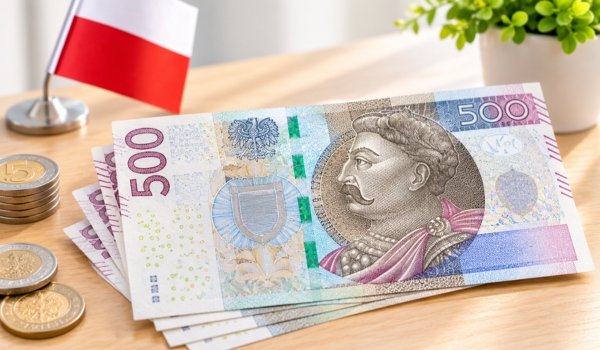
Poland introduced a 500 złoty banknote in 2017, featuring King John III Sobieski. While it is legal tender and produced by the National Bank of Poland, the note remains rare in everyday circulation due to its high face value, limited public distribution, and widespread public distrust of large-denomination cash.
Few things fascinate currency collectors and everyday citizens alike more than a banknote that technically exists but almost nobody has ever seen. The Polish 500 złoty note is exactly that — a legal, officially printed bill that quietly entered the monetary system in February 2017, yet remains a near-mythical object for the average Pole.
For a country where most daily transactions involve amounts well below 100 złoty, a 500 zł note occupies a strange space. It is real. It is valid. The National Bank of Poland (NBP) designed it, printed it, and issued it. And yet, years after its introduction, most Polish citizens have never physically handled one. Walk into a grocery store, a pharmacy, or a café and try to pay with a 500 zł note — the reaction from cashiers alone tells the whole story.
This article explores the history and design of Poland’s most elusive banknote, why it was introduced, and why it remains virtually invisible in everyday Polish life — even as the country’s economy grows and cashless payments dominate.
What Is the Polish 500 zł Banknote and When Was It Introduced?
The 500 złoty banknote was officially introduced into circulation by the National Bank of Poland on February 10, 2017. It became the highest-denomination note in Poland’s monetary system, sitting above the previously top-tier 200 złoty note. The NBP announced the introduction as a practical response to rising price levels and the growing need for a higher-denomination bill to facilitate large financial transactions.
The note was not a surprise. The NBP had been signaling its plans for years, and the 2017 launch came with a full public communication campaign — including educational materials about the banknote’s security features and its place in Polish monetary history.
According to the National Bank of Poland, the primary purpose of the 500 zł note was to reduce transaction costs and improve the efficiency of cash handling for businesses, financial institutions, and transport carriers who regularly move large amounts of physical currency. In that narrow sense, the note was designed more for the banking system than for the person buying bread at a corner shop.
Who Is Featured on the Polish 500 Złoty Note and What Does It Look Like?
The 500 złoty note features King John III Sobieski (Jan III Sobieski), one of Poland’s most celebrated monarchs, best known for leading the victorious Holy League forces at the Battle of Vienna in 1683 — a decisive moment in European history that halted the Ottoman advance into central Europe. His image anchors the front of the note, presented in a formal portrait style consistent with the historical theme used across Poland’s banknote series.
The reverse of the note depicts the Wilanów Palace near Warsaw, the royal residence commissioned by Sobieski himself. The combination of the king’s portrait and his palace gives the note a cohesive historical narrative that carries real cultural weight.
In terms of physical design, the note measures 160 × 77 mm and uses a deep green color palette as its dominant tone. The NBP incorporated an extensive array of security features, including:
- A holographic security stripe running vertically across the front of the note
- Color-shifting ink on the denomination numeral
- Watermarks visible when held to light, including a portrait of King Sobieski
- Microprinting and fine-line patterns that are difficult to replicate
- Tactile elements for visually impaired users, including raised print and special markings
The security architecture of the 500 zł note is considered among the most sophisticated in Poland’s banknote history. The NBP worked to ensure the note was resistant to counterfeiting at the highest available technical standard. For full details on the security features, the National Bank of Poland publishes official documentation on its website at nbp.pl.

Why Did the National Bank of Poland Introduce a 500 Złoty Note in 2017?
The decision to introduce the 500 zł denomination was rooted in economics and practicality, not any single political moment. Poland’s GDP had grown consistently through the 2000s and 2010s, raising average transaction values across sectors including real estate, wholesale trade, and financial services. A higher-denomination note reduced the number of physical bills needed for large payments, lowering handling costs and reducing wear on lower-denomination notes.
Central banks across Europe had been making similar adjustments. The European Central Bank retired the €500 note in 2019 — citing concerns about its use in illicit transactions — while Poland moved in the opposite direction, adding a high-denomination note to its portfolio. The NBP’s position was that a well-secured, clearly traceable high-denomination note could serve legitimate economic purposes without meaningfully increasing financial crime risk.
There was also a symbolic dimension. The 500 zł note completed the historical lineup on Poland’s banknote series, which features monarchs and rulers across denominations. Adding King John III Sobieski gave the series a natural endpoint and honored one of Poland’s most consequential historical figures.
Why Does the 500 Złoty Note Remain So Rare in Everyday Polish Life?
This is where the story gets genuinely interesting. The 500 zł note is legal tender. It circulates. The NBP has confirmed it is available through commercial banks. And yet the vast majority of Polish citizens rarely — if ever — encounter one in daily life.
Several factors explain this gap between official existence and practical reality.
High face value relative to everyday spending. In Poland, the average consumer transaction is far below 500 złoty. Most people use 50 and 100 złoty notes for routine purchases. A 500 zł note represents a significant sum — roughly equivalent to a substantial grocery shop, a utility bill, or a portion of a monthly rent payment. Its value makes it unsuitable for casual daily use.
Retailer and merchant reluctance. Many shops, restaurants, and kiosks in Poland simply refuse to accept 500 zł notes or cannot make change for them. This is especially true for smaller businesses and street vendors. Once consumers learn that large notes are routinely rejected, they stop carrying them — creating a self-reinforcing cycle of non-use.
The rise of cashless payments. Poland has experienced a dramatic shift toward card and mobile payments over the past decade. According to data published by the Polish Payment Standard (Polski Standard Płatności), contactless and mobile payments have surged significantly since 2020, reducing the need for high-denomination cash across all demographic groups. The 500 zł note arrived at precisely the moment when physical cash was beginning its structural decline in Polish daily life.
Public skepticism and distrust. When the note first launched, some Polish consumers and commentators expressed skepticism — questioning whether a 500 zł note was primarily useful for tax evasion or undeclared transactions. While this perception was not endorsed by the NBP, it contributed to a cultural wariness around the note that persists in some quarters.
Banking channel bias. Because the 500 zł note was partly designed for interbank and wholesale use, a significant portion of printed notes circulate within the financial system rather than reaching individual consumers through ATMs or bank teller transactions. Most ATMs in Poland dispense 50 and 100 złoty notes, not 500 zł notes.
How Does the 500 Złoty Note Compare to High-Denomination Banknotes Elsewhere in Europe?
High-denomination banknotes have a complicated reputation across Europe. The European Central Bank discontinued production of the €500 note in April 2019 — though existing notes remain legal tender — citing evidence from Europol and other law enforcement agencies that the denomination was disproportionately used in illicit financial activity. The decision was controversial, with critics arguing it penalized legitimate users while doing little to stop determined criminals.
Switzerland, by contrast, continues to issue the 1,000 Swiss franc note, which remains among the highest-value banknotes in regular use anywhere in the world. The Swiss National Bank defends the note on the grounds of user convenience and low counterfeiting rates.
Poland’s 500 zł note sits between these two philosophies. The NBP has maintained the note, defended its security credentials, and resisted calls to withdraw it — while acknowledging that its primary utility is in institutional rather than consumer settings. For an in-depth comparison of European high-denomination banknotes and their policy implications, the European Central Bank publishes regular reports at ecb.europa.eu.
What Do Currency Collectors and Numismatists Think About the 500 Złoty Note?
For numismatists — people who study and collect currencies — the 500 zł note has attracted genuine interest, partly because of its rarity in everyday life. Uncirculated specimens in pristine condition hold collector value, and certain early-print variants or notes with interesting serial number patterns command premiums in collector markets.
The Wilanów Palace reverse design is frequently cited by collectors as one of the more aesthetically successful elements of Poland’s modern banknote series. The detailed architectural engraving combined with the muted green palette gives the note a restrained elegance that appeals to those who appreciate classical banknote design.
For collectors interested in Polish numismatics, the Polish Numismatic Society (Polskie Towarzystwo Numizmatyczne) is a valuable resource for research, authentication, and community discussion.
The Future of the 500 Złoty Note in a Cashless Poland
Poland’s trajectory toward a cashless economy raises a legitimate question: does the 500 zł note have a long-term future? The NBP has not announced any plans to retire the note, and it continues to be produced and held in reserve by commercial banks. But the broader context — accelerating digital payment adoption, generational shifts in consumer behavior, and European discussions about digital currencies — means the note’s role will likely narrow further over time.
The European Central Bank is actively developing the digital euro, a central bank digital currency (CBDC) intended to complement physical cash across the eurozone. While Poland is not a eurozone member, the NBP has conducted its own research into digital currency concepts and is monitoring international developments closely. Updates on these discussions are available through official NBP communications at nbp.pl.
Final Thoughts: A Banknote That Tells Two Stories at Once
The 500 złoty note tells two stories simultaneously. The first is a story about Polish history — about King John III Sobieski, the Battle of Vienna, the grandeur of Wilanów Palace, and the pride of a nation that takes its historical narrative seriously. That story is beautifully told on a well-designed, technically sophisticated piece of currency.
The second story is about the gap between monetary policy intent and economic reality. The note was designed to serve a practical function. It does serve that function — but mostly behind the scenes, in bank vaults and wholesale transfer systems rather than in wallets and cash registers. For most Polish citizens, the 500 zł note remains more rumor than reality: something that definitely exists but that they’ve simply never held.
That gap, between official existence and everyday experience, is what makes the 500 złoty note genuinely fascinating — not just as a piece of currency, but as a small mirror held up to modern economic life.
Frequently Asked Questions About the Polish 500 Złoty Banknote
Is the Polish 500 złoty banknote legal tender?
Yes. The 500 złoty banknote is fully legal tender in Poland. It was officially introduced by the National Bank of Poland on February 10, 2017, and remains valid for all transactions. Retailers are not legally required to accept it, however, which is one reason many shops decline the note.
Who is on the Polish 500 złoty note?
The front of the 500 złoty note features King John III Sobieski, the Polish monarch best known for commanding the Holy League forces at the Battle of Vienna in 1683. The reverse depicts the Wilanów Palace near Warsaw, the royal residence associated with his reign.
Why don’t Polish shops accept the 500 złoty note?
Most retailers in Poland do not carry sufficient cash float to make change for a 500 złoty note, particularly for small purchases. There is also a cultural wariness around the note due to its high denomination and association with large, informal transactions. As a result, many shops simply refuse it, which has discouraged consumers from carrying the note.
Can I get a 500 złoty note from a Polish ATM?
Most ATMs in Poland dispense 50 and 100 złoty notes. The 500 zł note is available through bank tellers at commercial banks, but it is not routinely stocked by ATM machines. This limits consumer access to the note in everyday situations.
Is the 500 złoty note valuable to collectors?
Uncirculated 500 złoty notes in excellent condition can carry collector interest, particularly early print runs or notes with notable serial numbers. The note’s rarity in everyday life adds to its appeal among Polish numismatists. The Polish Numismatic Society (Polskie Towarzystwo Numizmatyczne) is a reliable resource for collectors.
Is Poland planning to withdraw the 500 złoty note?
As of 2026, the National Bank of Poland has not announced any plans to retire the 500 złoty note. It remains in production and in reserve at commercial banks, though its use in daily consumer transactions continues to decline as Poland shifts toward cashless payments.
