
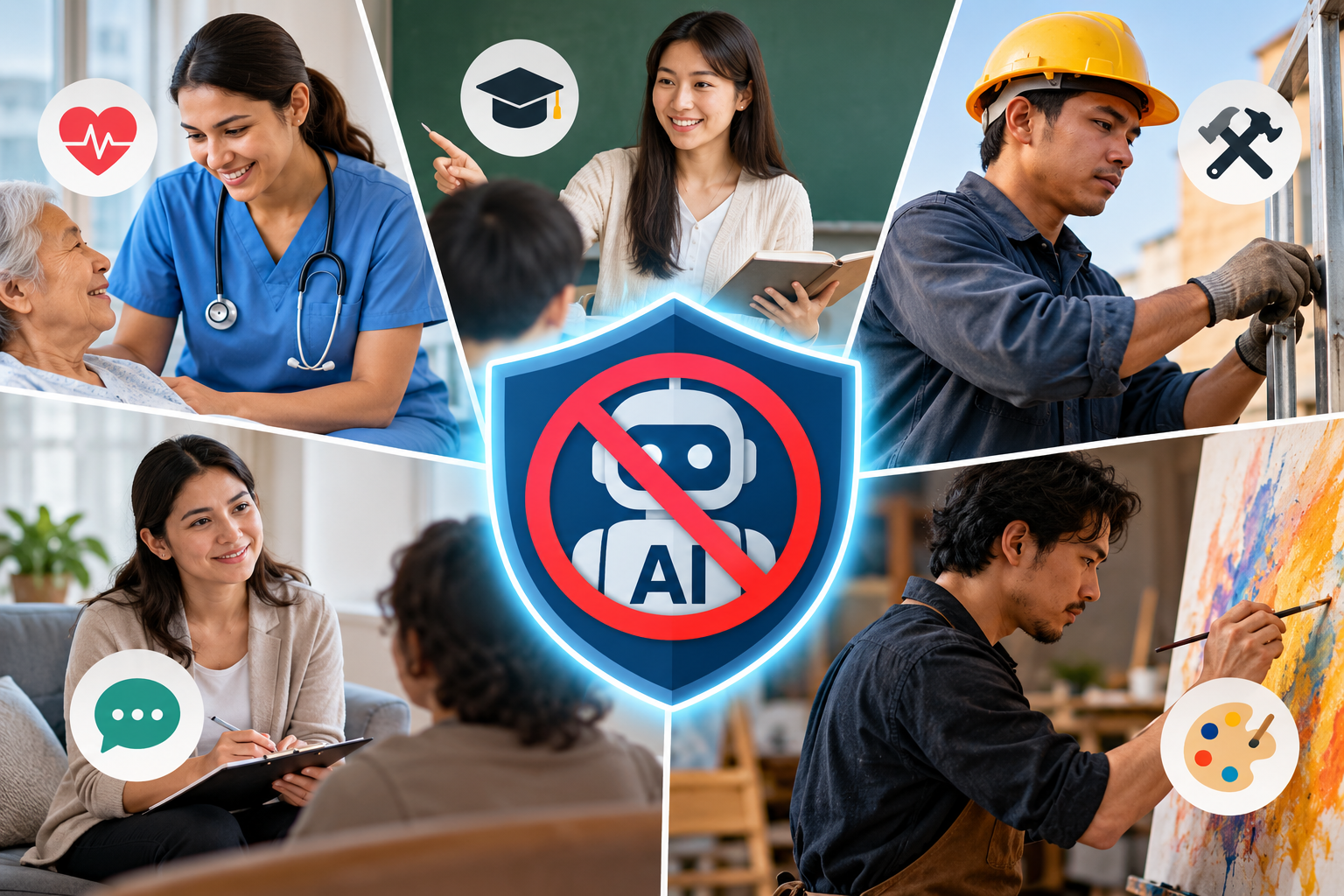
Quick answer: Jobs that require deep human judgment, physical dexterity, emotional intelligence, and complex interpersonal trust remain the most resistant to AI automation. Five standout examples are therapists and mental health counselors, skilled tradespeople, registered nurses, teachers, and social workers. These roles rely on empathy, hands-on adaptability, and ethical decision-making that current AI systems cannot replicate.
Artificial intelligence has already reshaped how millions of people work. Tools like ChatGPT draft emails, generate code, and summarize reports in seconds. Automation software now handles data entry, customer service tickets, and even basic legal document review. Naturally, this has left many workers wondering whether their job will still exist in five or ten years.
The truth is more nuanced than the doomsday headlines suggest. While AI excels at pattern recognition, repetitive tasks, and processing large volumes of information, it still struggles with jobs that demand physical adaptability, genuine human connection, or high-stakes ethical judgment. According to a 2023 report from the McKinsey Global Institute, occupations involving “unpredictable physical activities” and “managing and developing people” show the lowest technical automation potential of any job category.
This article breaks down five careers that remain largely insulated from AI disruption, and explains the specific human skills that make each one difficult to automate.
Table of Contents
Why Are Some Jobs More Resistant to AI Than Others?
AI models, including large language models and robotics systems, are built to recognize patterns in data. They perform best on tasks that are repetitive, rule-based, or heavily reliant on structured information. Jobs become AI-resistant when they require:
- Physical dexterity in unpredictable environments
- Emotional intelligence and trust-building
- Ethical judgment in ambiguous situations
- Creative problem-solving that draws on lived experience
- Hands-on manual skill that varies from one job site to the next
Understanding this distinction helps explain why a radiologist’s job may shift dramatically due to AI-assisted imaging, while a plumber’s job barely changes at all.
1. Therapists and Mental Health Counselors Rely on Trust AI Cannot Build
Mental health counseling depends on a therapeutic relationship built over time. Clients need to feel genuinely heard, and that sense of connection comes from nuanced human empathy, not scripted responses. While AI chatbots have emerged as supplementary tools for basic mood tracking or journaling prompts, licensed therapists interpret body language, tone shifts, and unspoken cues that no algorithm can fully process.
Choose a career in counseling if you value deep human connection over routine-based work, since this field consistently ranks among the least automatable professions in labor market studies.
2. Skilled Tradespeople Handle Physical Unpredictability AI Robots Struggle With
Electricians, plumbers, and HVAC technicians work in constantly changing physical environments. Every home, building, and job site presents unique layout challenges, wiring quirks, or pipe configurations. Robotics has made impressive strides in controlled factory settings, but the fine motor skills and situational judgment required to fix a leaking pipe in a cramped, decades-old basement remain far beyond current robotic capability.
Demand for these trades also continues to grow. The U.S. Bureau of Labor Statistics projects steady employment growth for electricians and plumbers through the next decade, driven partly by infrastructure investment and the fact that these roles simply cannot be outsourced to software.
3. Registered Nurses Combine Clinical Skill With Bedside Compassion
Nursing sits at the intersection of technical precision and emotional care. AI can assist with diagnostics, flag abnormal vital signs, or streamline administrative paperwork, but nurses still perform hands-on tasks like inserting IVs, adjusting care plans in real time, and comforting frightened patients and families. This blend of clinical judgment and compassionate presence is exactly why healthcare staffing shortages persist even as AI tools become more common in hospitals.
Nurses who continue building their credentials, whether through a bachelor’s degree or a master’s degree, often find even greater job security, since advanced specializations tend to be the hardest roles to automate.
4. Teachers Adapt Instruction in Ways AI Tutoring Tools Cannot Match
AI-powered tutoring platforms have grown increasingly sophisticated, and some schools now use them to supplement instruction. But a classroom teacher does far more than deliver content. Teachers read a room, adjust their pacing based on subtle student confusion, mediate conflicts, and motivate students through personal relationships built over an entire school year.
This is closely tied to the rise of personalized learning, where educators use data and human insight together to tailor instruction. AI can suggest which topics a student struggles with, but a teacher decides how to explain it in a way that actually resonates.
Teachers looking to stay ahead of classroom technology shifts can also explore free online courses with certificates to build new skills in educational technology without taking on the cost of a full degree program.
5. Social Workers Navigate Ethical Complexity AI Cannot Be Trusted With
Social workers make decisions that carry serious human consequences: assessing child welfare risks, coordinating crisis intervention, and connecting vulnerable populations with housing or mental health resources. These decisions require weighing competing ethical considerations, understanding cultural context, and building trust with people who are often in crisis.
No responsible organization would delegate these judgment calls to an algorithm, and licensing boards require extensive supervised training specifically because the stakes are too high for shortcuts.
What Should You Do If You’re Worried About AI Taking Your Job?
The safest career move isn’t necessarily avoiding technology, it’s building skills that complement it. Focus on developing emotional intelligence, hands-on technical expertise, or specialized judgment that AI tools are designed to support rather than replace. Workers in every field, from healthcare to education, are already finding that pairing traditional expertise with AI literacy makes them more valuable, not less.
If you’re considering a career change or want to future-proof your current role, start by identifying which of your daily tasks require genuine human judgment. Those tasks are your strongest asset in an AI-driven job market.
Frequently Asked Questions
Which jobs are considered the safest from AI automation?
Careers requiring emotional intelligence, physical dexterity in unpredictable settings, and ethical judgment are the safest from AI automation. Examples include therapists, skilled tradespeople, registered nurses, teachers, and social workers.
Will AI eventually replace healthcare workers like nurses?
AI is more likely to assist nurses with administrative tasks and diagnostics than replace them entirely. Hands-on patient care, emotional support, and real-time clinical judgment remain difficult for AI systems to replicate.
How can teachers prepare for AI’s growing role in education?
Teachers can prepare by learning how to use AI-powered tools for personalized learning while focusing on the human skills, like mentorship and classroom management, that technology cannot replace.
Is it worth pursuing a trade career instead of a college degree because of AI?
Skilled trades offer strong job security because they require physical adaptability that robotics has not mastered. However, the right path depends on individual interests, since fields like nursing or education also remain resistant to automation while requiring formal education.
What skills should workers develop to stay competitive alongside AI?
Workers should prioritize emotional intelligence, complex problem-solving, and hands-on technical skills. Combining these strengths with basic AI literacy makes workers more valuable across nearly every industry.
