

Ever study for three hours and still blank out on the test? You’re not alone. Most students aren’t lazy or “bad at studying.” They’re just using study techniques that feel productive but don’t actually stick.
The good news? A handful of methods, backed by real cognitive science, work way better than rereading your notes for the tenth time. Let’s get into them.
Why Most of the Ways You Study Aren’t Working
Here’s the thing. Highlighting your textbook feels like progress. So does rereading your notes until the words blur together.
But here’s what’s actually happening: your brain recognizes the material. Recognition feels like knowledge. It isn’t.
Recognizing an answer on a page is completely different from pulling that answer out of your brain during a test. That gap is why so many students feel confident the night before an exam, then freeze the next day.
So step one is simple: stop treating “familiar” as “learned.”
What Is the Most Effective Study Technique?
If you only take one thing from this article, make it this: active recall beats almost everything else.
Active recall means testing yourself instead of just reviewing material. You force your brain to retrieve information, not just recognize it.
Here’s how to actually do it:
- Close your notes and write down everything you remember about a topic
- Use flashcards and try to answer before flipping them
- Cover your notes and explain the concept out loud, like you’re teaching it
- Do practice questions instead of just reading the answer key
This works because retrieving information strengthens the memory pathway. Every time you struggle to recall something and get it right, that memory gets a little more solid.
It feels harder than rereading. That’s actually a good sign.
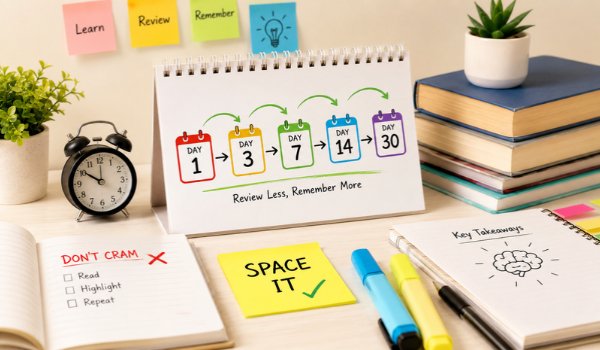
Spaced Repetition: Stop Cramming, Start Spacing
Cramming gets a bad reputation for a reason. It can help you scrape by on a test tomorrow. It does almost nothing for what you’ll remember next month.
Spaced repetition fixes that. Instead of studying a topic once for three hours, you study it in shorter sessions spread across days or weeks.
A simple version looks like this:
- Learn the material today
- Review it again in 2 days
- Review it again in a week
- Review it again in a month
Each review takes less time than the last, because the memory is already there. You’re just refreshing it before it fades.
This is one of the most well-supported study techniques out there, and it’s also one of the easiest to actually plan around a busy school week.
Why Do I Forget What I Study?
Short answer: your brain is designed to forget things it doesn’t use.
Without review, memory tends to fade fast, especially in the first day or two after learning something. This is sometimes called the “forgetting curve.”
But every time you revisit the material, especially through active recall, that curve flattens out. The memory sticks around longer with less effort each time.
So forgetting isn’t a sign you’re bad at studying. It’s just your brain doing what brains do. Spacing and recall are how you work with that, instead of against it.
The Pomodoro Method — Study in Short, Focused Bursts
Ever sit down to study and lose focus after 20 minutes, even though you planned for two hours?
That’s normal. Attention naturally drops off over time, especially with a phone nearby.
The Pomodoro method works around this:
- Study for 25 minutes, no distractions
- Take a 5-minute break
- Repeat 3–4 times
- Take a longer 15–20 minute break
Short, timed sessions make studying feel less overwhelming. You’re not staring down “study for three hours.” You’re just doing one 25-minute round.
You can adjust the timing to fit you. Some students prefer 45-minute sessions with 10-minute breaks. The key idea stays the same: focused bursts beat foggy marathons.
Why Interleaving Beats One-Topic Marathons
Most students study one subject for a long stretch, then move to the next. It feels organized. It’s often not the best approach.
Interleaving means mixing different topics or problem types in the same session. Instead of doing 20 algebra problems in a row, you might mix algebra, geometry, and word problems together.
It feels messier in the moment. You might even do a little worse while practicing this way.
But it forces your brain to actually identify which method or concept applies, instead of just running the same motion on autopilot. That skill — knowing which tool to use and when — is exactly what you need on a real exam, where questions aren’t neatly sorted by type.

How Many Hours Should Students Study a Day?
There’s no magic number that works for everyone. It depends on your course load, how close you are to exams, and how you study.
That said, a few general guidelines help:
- Quality beats quantity. Two focused hours with active recall beat five distracted hours of rereading.
- Break big study time into sessions, not one long block.
- Build in review days, not just “learn new stuff” days.
- Watch for diminishing returns — past a certain point, tired studying just wastes time you could spend sleeping.
A realistic goal for most students is somewhere around 2–4 focused hours a day outside class, adjusted around test dates. During exam weeks, that naturally goes up, but the same “short, focused sessions” rule still applies.
Best Way to Study for Exams in a Short Time
Got a test in two days and barely started? Here’s a plan that won’t waste your limited time.
- Skip rereading. Go straight to practice questions or past exams.
- Focus on what you don’t know. Sort topics into “solid” and “shaky,” then spend most of your time on shaky.
- Use active recall in short bursts. Flashcards or self-quizzing beat passive review every time, especially under time pressure.
- Sleep before the test. Pulling an all-nighter can undo the work you just put in, since memory needs sleep to lock in properly.
- Do one final light review the morning of, instead of cramming new material at the last minute.
This won’t replace weeks of proper spaced study. But it’s the most efficient way to use the time you’ve actually got.
Small Habits That Make Every Technique Work Better
Technique matters, but so does the environment around it. A few small changes make a real difference:
- Put your phone in another room. Notifications break focus more than most students realize.
- Study in the same spot regularly. Your brain starts associating that space with focus mode.
- Protect your sleep. Memory consolidation happens while you sleep, so cutting sleep to study more often backfires.
- Explain concepts to someone else (or even out loud to yourself). If you can’t explain it simply, you probably don’t know it as well as you think.
None of these techniques need fancy tools or apps to work. A notebook, some flashcards, and a bit of planning go a long way. If you want more practical guides like this one for school and beyond, Trafily’s Education section has more articles worth a look.
Getting Started This Week
You don’t need to overhaul everything overnight. Pick one technique — active recall is a great place to start — and use it for your next study session.
Add spacing and short focused sessions once that feels natural. Small, consistent changes beat a perfect system you never actually stick to.
That’s really what makes study techniques work in the first place: not the technique itself, but actually using it.
