

Ever close your books after a long study session and realize you can’t remember half of it? That’s not a “you” problem. It usually means you never learned how to study effectively in the first place.
Nobody teaches this in school. You’re handed textbooks and told to “study,” but no one explains what actually makes studying work. So let’s fix that.
What Does “Studying Effectively” Actually Mean?
Here’s the thing. Studying effectively isn’t about how many hours you put in. It’s about how much of that time actually turns into knowledge you can use later.
Two students can study the same chapter for the same two hours. One walks away able to explain it cold. The other barely remembers the topic the next day.
The difference isn’t intelligence. It’s technique, focus, and environment. All three matter, and most students only ever think about one of them.
What Makes Studying Effective?
A few things separate effective studying from time wasted staring at a page:
- Active engagement — testing yourself, explaining concepts out loud, not just reading
- Focused attention — no phone, no tab-hopping, one thing at a time
- The right environment — a space your brain associates with focus, not distraction
- Realistic pacing — shorter, focused sessions instead of one long, foggy block
- Honest self-checks — knowing what you actually understand vs. what just looks familiar
None of these require expensive tools or apps. They’re mostly about how you approach the time you already have.
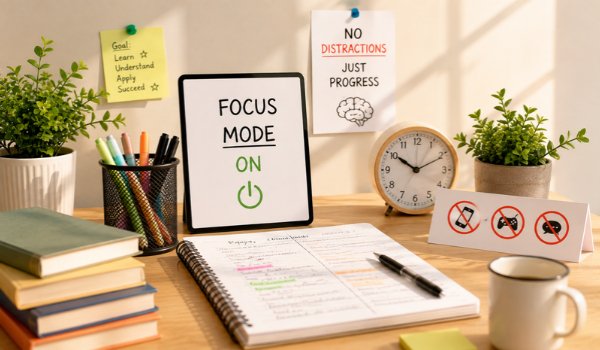
How to Study Effectively Without Getting Distracted
Distraction is probably the single biggest thing killing your study sessions. And it’s sneakier than people think.
Even a quick glance at a notification pulls your focus away. Getting back to full concentration afterward takes longer than most students realize. So those “quick checks” add up fast.
A few things that genuinely help:
- Put your phone in another room, not just face-down on the desk
- Use a website blocker during study blocks if tabs are your weak spot
- Study in short, timed bursts (25–45 minutes), so full focus feels doable
- Tell people around you you’re studying, so you’re not interrupted mid-thought
You don’t need perfect willpower. You need fewer chances for distraction to reach you in the first place.
Set Up a Study Environment That Works For You
Where you study matters more than most students give it credit for.
Studying in bed feels comfortable, but your brain starts linking that space with sleep and relaxing, not focus. Same goes for studying in front of the TV.
Try to build a spot that’s just for studying:
- A desk or table, not a bed or couch
- Decent lighting, ideally natural light if you can get it
- Minimal clutter in your direct line of sight
- The same spot most days, so your brain starts recognizing it as “focus mode”
You don’t need a perfect setup. You just need consistency.
How Long Should an Effective Study Session Be?
Shorter than you probably think.
Focus naturally drops off after a while, and pushing through past that point usually means low-quality studying, not more learning. Most students do better with sessions in the 25–50 minute range, followed by a short break.
A simple structure to try:
- Study for 25–45 minutes, fully focused
- Take a 5–10 minute break, away from your phone
- Repeat for 2–4 rounds
- Take a longer break after that
This beats sitting down for a shapeless three-hour block. Shorter sessions keep your attention sharp instead of slowly fading out.
Why Do I Study for Hours and Still Forget Everything?
This usually comes down to one thing: passive review.
Rereading notes and highlighting text feels productive. But it mostly builds familiarity, not memory. You recognize the material without being able to actually recall it later.
The fix is active recall — testing yourself instead of just reviewing. Close your notes and try to explain the topic from memory, or use flashcards where you answer before flipping them over.
Pairing this with spaced review (revisiting material across several days, not just once) makes a huge difference in what actually sticks. If you want a deeper breakdown of these methods, our guide on study techniques for students covers them in more detail.
Studying Effectively When You Don’t Feel Motivated
Motivation isn’t reliable. Some days it shows up, most days it doesn’t.
Effective studiers don’t wait around for motivation. They rely on routine instead.
A few ways to make this easier:
- Study at the same time each day, so it becomes automatic, not a decision
- Start with just 10 minutes. Momentum usually kicks in once you begin
- Break big tasks into small ones. “Study biology” feels huge. “Review 10 flashcards” doesn’t
- Remove friction. Have your notes and materials ready before you sit down
Discipline isn’t about feeling ready. It’s about starting anyway, even when you don’t.
How to Tell If Your Studying Is Actually Working
Here’s a simple gut check. Can you close your notes and explain the topic out loud, in your own words, without peeking?
If yes, it’s working. If you freeze or need to check constantly, you’re not there yet, no matter how many hours you’ve logged.
A few honest ways to check your progress:
- Try a practice question without looking at your notes first
- Explain the concept to a friend, or even to yourself
- Notice if you’re recalling the answer or just recognizing it
If it feels easy because you’ve seen it before, that’s recognition. If you can pull it from memory cold, that’s real learning.
Ready to Study Smarter?
Effective studying isn’t about grinding longer. It’s about focus, the right techniques, and a routine you can actually stick to.
Start small. Fix one thing this week, whether that’s putting your phone away or switching to active recall. For more practical strategies like this, check out Trafily’s Education section for guides built specifically for students.
