
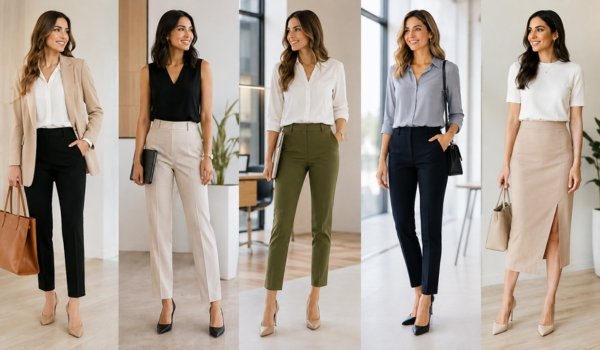
Business casual for women is a dress code that balances professionalism with everyday comfort. It typically includes tailored trousers, blouses, midi skirts, blazers, and smart flats or low heels—avoiding overly formal suits or overly relaxed items like ripped jeans, athleisure, or flip-flops.
The term “business casual” has confused working women for decades. Unlike a strict formal dress code, it doesn’t come with a clearly defined rulebook. Ask five people what it means, and you’ll likely get five different answers. That ambiguity makes getting dressed for work harder than it should be—and the stakes feel high when you’re trying to make a strong impression.
Here’s the reality: business casual has evolved significantly. Remote work, hybrid schedules, and shifting workplace cultures have all redefined what’s considered appropriate and polished. What worked in a 2010 office might feel stiff and outdated in a 2025 startup, while what flies at a creative agency might not cut it at a financial firm.
This guide breaks down exactly what business casual means for women today—covering the core pieces to own, what to avoid, how to dress for different industries, and how to build a wardrobe that works hard without feeling like a costume. By the end, you’ll have a clear, practical framework for dressing confidently at work, every day.
What Are the Core Pieces Every Woman Needs for a Business Casual Wardrobe?
Building a business casual wardrobe doesn’t require a full closet overhaul. It starts with a handful of versatile, well-fitting pieces that you can mix, match, and style in multiple ways.
Tailored trousers are the backbone of business casual dressing. A well-cut pair in a neutral tone—navy, camel, charcoal, or black—can be styled with a tucked-in blouse for a client meeting or paired with a knit sweater for a relaxed Friday. Look for a straight-leg or wide-leg silhouette, which reads as polished without feeling overly formal.
Blazers are equally essential. A structured blazer instantly elevates almost any outfit. Wear it over a simple white tee and tailored trousers, or layer it over a midi dress. Neutral tones like beige, ivory, or charcoal are the most versatile, but a blazer in a muted plaid or subtle pattern can add personality without crossing into casual territory.
Midi skirts are one of the most underrated business casual staples. A midi length—typically hitting between the knee and ankle—strikes a balance that feels both professional and modern. Pair a satin midi skirt with a fitted turtleneck, or choose a pleated A-line style with a button-down blouse.
Blouses and button-downs round out the top half of a business casual wardrobe. Opt for quality fabrics like silk, cotton, or linen, and look for clean lines and minimal detailing. Avoid anything sheer, low-cut, or overly embellished for core work settings.
Shoes matter more than many women realize. Block-heeled pumps, pointed-toe flats, leather loafers, and ankle boots all fall comfortably within business casual territory. Avoid open-toe sandals, stilettos, sneakers (unless your workplace explicitly allows them), and anything with excessive embellishment.
For building your foundational wardrobe, resources like Who What Wear’s business casual guide and The Zoe Report offer solid visual references and shopping recommendations across multiple price points.
What Should Women Avoid Wearing in a Business Casual Environment?
Knowing what not to wear is just as valuable as knowing what to wear. Business casual occupies a specific zone between smart-casual and formal professional—and there are clear items that fall outside its boundaries on both ends of the spectrum.
On the overly casual side, avoid ripped or distressed denim, graphic T-shirts, athleisure wear (including leggings worn as trousers), hoodies, flip-flops, and anything that looks like weekend loungewear. Even if your workplace has a relaxed culture, these items typically undercut a professional image.
On the overly formal end, a full matching pantsuit or skirt suit with a structured jacket can tip into formal business territory, depending on how it’s styled. Business casual is intentionally more relaxed than that—so swapping the matching suit jacket for a softer blazer or an unstructured cardigan can recalibrate the look.
A few other items to approach with caution: very short hemlines, low necklines, and clothing with slogans or bold graphics. These don’t necessarily break a dress code, but they can shift the focus away from your work and credentials—which, in most professional settings, is counterproductive.

How Does Business Casual Differ Across Industries for Women?
One of the most important things to understand about business casual is that it’s not a universal standard. The dress code shifts considerably depending on your industry, company culture, and even your specific role.
In finance, law, and consulting, business casual still leans conservative. Think structured trousers, tailored blazers, silk blouses, and closed-toe heels. The expectation is polished and understated—minimal jewelry, neutral palettes, and clean silhouettes. Even on casual Fridays, the bar remains higher than in other industries.
In tech and startups, business casual is far more relaxed. Many tech companies have effectively replaced formal dress codes with smart-casual, where well-fitted dark jeans, quality knitwear, and clean sneakers are accepted. Women in these environments have more flexibility to express personal style, incorporate bold colors, and experiment with silhouette.
In healthcare and education, practicality shapes the dress code. Business casual in these fields tends to prioritize comfort and functionality—flat shoes, wrinkle-resistant fabrics, and minimal accessories. Looking put-together matters, but extreme formality isn’t expected or practical.
In creative industries like advertising, media, and design, the rules loosen further. Statement pieces, mixed prints, and fashion-forward silhouettes are often welcomed or even encouraged. Here, business casual functions more as a baseline than a ceiling.
When starting a new job, the safest approach is to observe what senior colleagues and team leaders wear before committing to a wardrobe direction. Style sites like Refinery29 and Who What Wear regularly publish industry-specific style breakdowns worth bookmarking.
Why Does Fit Matter More Than Price When Dressing Business Casual?
Across all industries and dress codes, fit is the single most important factor in looking professional. A well-tailored piece from a mid-range retailer will consistently outperform an expensive item that doesn’t fit properly.
Clothing that fits well communicates attention to detail—a quality that translates directly to how others perceive your competence and credibility in a professional setting. Baggy trousers, oversized blazers, and ill-fitting blouses can make even high-quality garments look sloppy. Conversely, a simple, well-fitting trouser and blouse combination reads as put-together and intentional regardless of cost.
Basic tailoring services—hemming trousers, taking in a blazer, or adjusting shoulder seams—are relatively affordable and make a dramatic difference. Many dry cleaners and local tailors offer these alterations for under $30 per item.
If budget is a consideration, retailers like Banana Republic, ASOS, & Other Stories, and Quince consistently deliver quality business casual options across a wide range of price points.
How Can Women Build a Business Casual Capsule Wardrobe That Works Year-Round?
A capsule wardrobe approach—where a small number of versatile, high-quality pieces are designed to work together—is particularly effective for business casual dressing.
Start with a neutral base: two to three pairs of tailored trousers (black, navy, and a neutral like camel or grey), two blazers (one neutral, one with a subtle pattern or texture), and three to five tops in muted tones. Add a midi skirt and one or two dresses that can be layered with blazers or cardigans, and round out the wardrobe with two to three shoe options covering flats, low heels, and ankle boots.
From this foundation, seasonality is handled through fabric choices and layering. In summer, linen trousers, sleeveless blouses, and breathable knits keep the look professional without overheating. In winter, cashmere turtlenecks, wool blazers, and thicker trousers maintain the same level of polish.
Accessories—a structured bag, a simple watch, minimal jewelry, and a quality belt—add finishing touches without requiring regular investment. Keep accessories understated in more conservative workplaces and slightly bolder in creative environments.
What Are the Most Common Business Casual Mistakes Women Make—and How Can They Fix Them?
Even with the best intentions, a few common mistakes can undermine a business casual look.
Treating all fabrics equally is one of them. Fabric quality and texture communicate professionalism in ways that silhouette alone cannot. Polyester blouses, shiny synthetic trousers, and thin jersey fabrics can look cheap under office lighting. Investing in natural or high-quality blended fabrics—cotton, linen, wool, silk, or quality ponte knit—makes a visible difference.
Ignoring grooming and finishing details is another. Wrinkled clothing, scuffed shoes, and worn-out accessories can overshadow an otherwise strong outfit. A quick steam before heading out and regular shoe maintenance go a long way.
Over-accessorizing can also shift a professional outfit toward casual. Stacking multiple chunky bracelets, wearing statement earrings with a statement necklace, or carrying an oversized novelty bag dilutes the polished effect of an otherwise strong outfit. Choose one focal accessory and let the rest of the look breathe.
Finally, ignoring workplace context is perhaps the most common mistake. Wearing a maximalist, fashion-forward outfit into a conservative financial firm signals a mismatch in judgment—regardless of how stylish the look is. Reading the room and calibrating accordingly is its own professional skill.
The Bottom Line: How to Dress for Business Casual With Confidence
Business casual is not a rigid uniform—it’s a mindset. The goal is to appear professional, prepared, and appropriately polished for your specific environment, while still being comfortable enough to do your best work.
Start with well-fitting, quality basics in neutral tones. Learn the norms of your specific industry and workplace before pushing boundaries. Invest in tailoring, maintain your clothing and shoes, and use accessories with intention rather than excess.
Over time, business casual dressing becomes second nature. You stop thinking about it as a set of restrictions and start treating it as a creative framework—a way to present yourself deliberately and professionally, every single day.
For further reading, Business Insider’s guide to workplace dress codes and The Cut’s style section offer regularly updated, real-world guidance on professional dressing across industries.
Frequently Asked Questions About Business Casual for Women
Are jeans business casual for women?
Plain, dark-wash, well-fitted jeans without distressing or embellishment are accepted as business casual in many workplaces—particularly in tech, creative industries, and startups. In more conservative environments like law, finance, or corporate settings, jeans are generally not considered business casual. When in doubt, opt for tailored trousers instead.
What shoes are appropriate for business casual women’s outfits?
Leather or faux-leather loafers, pointed-toe flats, block-heeled pumps, and clean ankle boots all fall within business casual standards. Avoid flip-flops, athletic sneakers, and overly embellished sandals. In creative or tech workplaces, minimalist white sneakers are increasingly accepted as part of a business casual look.
Can women wear dresses for business casual?
Yes. Midi dresses, wrap dresses, and shirt dresses in solid colors or subtle patterns are well-suited to business casual dress codes. Keep hemlines at or below the knee, choose structured fabrics over jersey or clingy materials, and layer with a blazer or cardigan to add polish.
What is the difference between business casual and smart casual for women?
Business casual is generally more formal than smart casual. Business casual assumes a professional context—an office, client meeting, or corporate environment—and prioritizes polished, structured pieces. Smart casual allows for more relaxed items like quality jeans and knitwear, and is typically used for social or semi-professional settings rather than formal workplaces.
How should women dress business casual for a job interview?
For a job interview, err on the side of more formal rather than less, even if the company’s day-to-day dress code is relaxed. A tailored blazer, well-fitted trousers or a midi skirt, a clean blouse, and closed-toe shoes create a strong, professional first impression. Research the company culture in advance to calibrate accordingly.
