
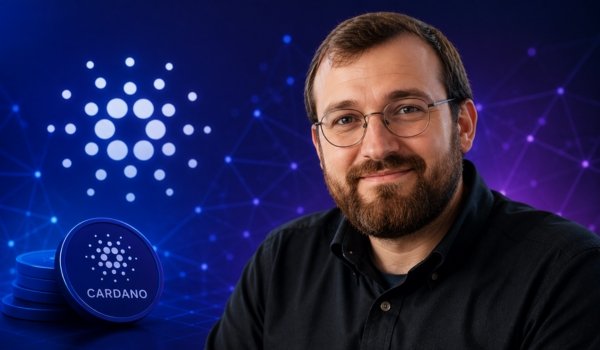
Charles Hoskinson is a mathematician, entrepreneur, and blockchain pioneer best known as the co-founder of Ethereum and the founder of Cardano (ADA). Hoskinson built Input Output Global (IOG) to advance peer-reviewed blockchain research and has become one of the most influential—and polarizing—figures in the cryptocurrency industry.
Few names carry as much weight in the blockchain space as Charles Hoskinson. He helped build Ethereum from the ground up, walked away from it over a fundamental disagreement, and then went on to create Cardano—a blockchain platform designed from scratch using academic research and formal verification methods. That trajectory alone makes Hoskinson worth understanding. But the full story is far richer than a simple rise-and-fall-and-rise narrative.
Hoskinson sits at a unique intersection: part mathematician, part entrepreneur, part philosopher, part provocateur. He live-streams for hours from his ranch in Wyoming, debates critics in real time, and funds open-source blockchain research across developing economies. He is simultaneously celebrated as a visionary and criticized as a polarizing figure who overpromises. Understanding who he is means understanding how he thinks—and how that thinking has shaped some of the most ambitious projects in the history of decentralized technology.
This article covers Hoskinson’s early life, his path into cryptocurrency, the founding of Cardano, his leadership philosophy, and the ongoing debates that surround him. By the end, you’ll have a clear picture of why Hoskinson remains one of the most consequential figures in the crypto ecosystem—regardless of where you stand on his work.
What Is Charles Hoskinson’s Background and How Did He Get Into Cryptocurrency?
Charles Hoskinson was born on November 5, 1987, in Hawaii and grew up in Colorado. He studied analytic number theory at the University of Colorado Boulder, though he left before completing his PhD. His academic foundation in mathematics would later become central to his philosophy that blockchain protocols should be built on provable, peer-reviewed science rather than intuition or rapid experimentation.
His entry into cryptocurrency came in the early days of Bitcoin. Before co-founding Ethereum, Hoskinson ran a Bitcoin education initiative and became deeply embedded in early crypto communities. He was drawn not just to the financial applications of blockchain but to its potential as infrastructure for human coordination—a decentralized layer that could replace trust in institutions with trust in code.
That ideological conviction brought him into contact with Vitalik Buterin in 2013, and together they became two of the eight co-founders of Ethereum. Hoskinson served as CEO of the Ethereum project during its foundational phase and was instrumental in securing early funding and building organizational structure around what was, at the time, a radical idea: a programmable blockchain.
Why Did Charles Hoskinson Leave Ethereum, and What Happened Next?
Hoskinson’s departure from Ethereum in 2014 is one of the most discussed events in crypto history, largely because of what it reveals about the project’s early culture. The core disagreement came down to governance and commercialization. Hoskinson wanted to build Ethereum as a for-profit company with a clear corporate structure. Vitalik Buterin and other co-founders wanted to keep it as a non-profit foundation. The philosophical gap proved irreconcilable, and Hoskinson was asked to leave.
He has discussed the fallout candidly in numerous interviews and live streams, and accounts of exactly what happened differ depending on the source. What is consistent across all versions is that the split was messy, emotional, and consequential. It also turned out to be clarifying.
Rather than re-entering someone else’s project, Hoskinson teamed up with Jeremy Wood—another Ethereum alumnus—to found Input Output Global (IOG, formerly IOHK) in 2015. IOG became the research and development company behind Cardano. The founding premise was straightforward but ambitious: blockchain protocols had been built too hastily, with insufficient mathematical rigor. IOG would take a different approach, publishing peer-reviewed academic papers before writing a single line of production code.
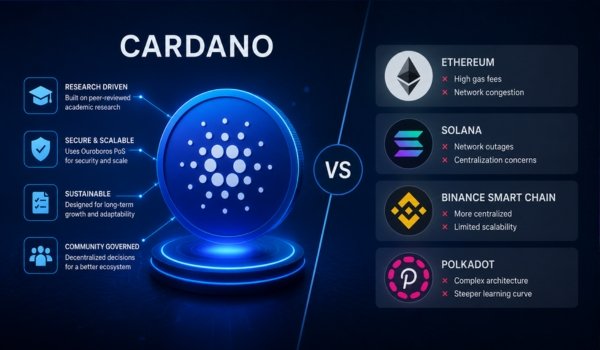
What Is Cardano and How Does It Differ From Other Blockchain Platforms?
Cardano is a third-generation blockchain platform designed to address the perceived shortcomings of earlier networks like Bitcoin and Ethereum. It launched its mainnet in 2017 and is built on the Haskell programming language, known for its reliability in safety-critical systems. The native token, ADA, is named after Ada Lovelace, the 19th-century mathematician widely recognized as the first computer programmer.
What sets Cardano apart from most blockchain platforms is its research-first methodology. IOG has published over 170 peer-reviewed academic papers, many in collaboration with universities including the University of Edinburgh, the Tokyo Institute of Technology, and the University of Wyoming. The consensus mechanism powering Cardano, called Ouroboros, was the first proof-of-stake protocol to be mathematically proven secure—a landmark achievement in cryptography published in 2017.
You can explore the full library of Cardano-related research at the official IOG research portal: https://iohk.io/en/research/
Cardano’s development has followed a phased roadmap divided into five eras—Byron, Shelley, Goguen, Basho, and Voltaire—each named after historical figures in mathematics and literature. This structured approach is deliberate. Hoskinson has argued repeatedly that the cryptocurrency industry suffers from shipping code before it is ready, leading to hacks, exploits, and protocol failures that undermine user trust.
The tradeoff, however, is speed. Ethereum introduced smart contracts years before Cardano’s smart contract functionality went live in 2021. Critics have argued that Cardano’s methodical pace allowed competitors to capture developer mindshare, and that peer review alone does not guarantee real-world adoption. Hoskinson’s supporters counter that stability and security matter more at scale, particularly for applications in financial infrastructure and public identity systems in emerging economies.
What Are Charles Hoskinson’s Most Significant Contributions to Blockchain Development?
Beyond Cardano itself, Hoskinson’s contributions to the blockchain space span technical research, education, and policy advocacy. A few stand out as particularly significant.
Ouroboros and Proof-of-Stake Research: The Ouroboros consensus protocol family—which now includes multiple versions including Ouroboros Praos and Ouroboros Genesis—represented a major academic contribution to the field. Before Ouroboros, proof-of-stake systems existed, but none had been formally proven secure in the cryptographic sense. This work provided a theoretical foundation that influenced broader industry thinking about energy-efficient consensus.
Financial Inclusion Initiatives in Africa: Hoskinson has invested significant IOG resources into partnerships with African governments and institutions, most notably a deal signed with the Ethiopian Ministry of Education in 2021 to provide blockchain-based academic credentials to five million students. IOG has also partnered with organizations in Tanzania, Kenya, and Georgia. These projects represent Hoskinson’s belief that blockchain’s most meaningful applications will emerge not in Silicon Valley, but in regions where existing institutional infrastructure is weak or absent.
Plutus and Marlowe Smart Contract Languages: IOG developed Plutus, a smart contract platform for Cardano built on Haskell, and Marlowe, a domain-specific language designed for financial contracts. Marlowe is particularly notable because it allows non-programmers to build and deploy financial agreements on-chain without needing deep coding expertise. For more on Cardano’s developer ecosystem, the official Cardano developer portal provides comprehensive documentation: https://developers.cardano.org/
Advocacy for Self-Sovereign Identity: Hoskinson has been a consistent advocate for self-sovereign identity (SSI) systems, where individuals control their own credentials on a blockchain without relying on a government or corporation as an intermediary. IOG’s Atala PRISM product is the commercial implementation of this vision, and it underpins the Ethiopian education partnership.
What Controversies and Criticisms Surround Charles Hoskinson?
Hoskinson is not without controversy. His public persona—combative, unfiltered, prone to lengthy YouTube monologues—generates as much criticism as admiration. Several recurring criticisms are worth engaging with seriously.
The first concerns delivery timelines. Cardano’s development has frequently fallen behind its stated roadmap, and features promised years in advance have taken longer than expected to ship. Smart contract functionality, for instance, was anticipated long before its 2021 launch. Hoskinson and IOG have defended these delays as evidence of rigor rather than dysfunction, but the gap between promises and delivery has fueled persistent skepticism in crypto communities.
The second criticism involves Hoskinson’s personal conduct online. He has blocked critics on social media, engaged in public disputes with other blockchain developers, and made statements that many in the industry found unnecessarily combative. His detractors argue that this behavior is unbecoming of a leader asking institutions and governments to trust his platform. His defenders argue that his willingness to engage directly—even confrontationally—reflects genuine transparency.
A third area of debate involves decentralization. Critics have pointed out that a significant portion of ADA’s initial supply was held by IOG, the Cardano Foundation, and early investors, raising questions about how decentralized the network truly is. Hoskinson has addressed these concerns through Cardano’s Voltaire governance phase, which is designed to transfer protocol governance entirely to ADA holders—though that transition remains ongoing.
What Is Charles Hoskinson’s Vision for the Future of Blockchain Technology?
Hoskinson has articulated a long-term vision that extends well beyond Cardano’s current capabilities. He sees blockchain as the foundation of a new kind of internet—one where individuals control their data, their identity, and their financial lives without depending on centralized platforms. He refers to this vision as the “third generation” of blockchain, contrasting it with Bitcoin’s first-generation focus on digital currency and Ethereum’s second-generation introduction of programmable contracts.
Central to this vision is interoperability. Hoskinson has consistently argued that the crypto industry’s fragmentation—dozens of competing chains with limited ability to communicate—is one of the biggest barriers to mainstream adoption. IOG has invested in research on cross-chain bridges and has been involved in discussions around industry-wide standards that could allow different blockchains to exchange value and data seamlessly.
He also talks frequently about governance at scale. As blockchain systems grow to serve millions or billions of users, the question of how those systems are upgraded, modified, and governed becomes pressing. Cardano’s treasury system and on-chain voting mechanisms are early attempts to solve this problem in a decentralized way, and Hoskinson views them as prototypes for much larger governance experiments.
You can follow Charles Hoskinson’s ongoing commentary, research updates, and announcements directly through the official Cardano Foundation: https://cardanofoundation.org/
What Does the Legacy of Charles Hoskinson Tell Us About Crypto’s Maturation?
Hoskinson’s career is, in many ways, a lens through which to examine the entire arc of the cryptocurrency industry. He was present at the creation of Ethereum, witnessed firsthand how ideological disagreements can fracture even the most promising collaborations, and then spent the following decade building something designed to avoid those same failure modes.
Whether Cardano ultimately fulfills its ambitions or not, Hoskinson has already made contributions to blockchain research and discourse that will outlast any single platform. The insistence on peer review, the focus on developing-world adoption, and the push for formal governance mechanisms have all influenced how the broader industry thinks—even among those who disagree with his approach or his style.
His legacy will be shaped by whether the gap between Cardano’s research pedigree and its real-world adoption eventually closes. The tools exist. The academic foundation is unusually strong. What remains is execution at scale—and that challenge will define the next chapter of Hoskinson’s story.
Frequently Asked Questions About Charles Hoskinson
Who is Charles Hoskinson in simple terms?
Charles Hoskinson is a mathematician and entrepreneur who co-founded Ethereum and later founded Cardano, one of the largest blockchain platforms by market capitalization. He leads Input Output Global (IOG), the research and development company that builds Cardano’s technology.
What is Charles Hoskinson’s net worth?
Hoskinson’s exact net worth is not publicly disclosed. Various estimates have placed it in the hundreds of millions to over one billion dollars, largely tied to his ADA holdings and equity in IOG. These figures fluctuate significantly with cryptocurrency market conditions.
Why did Charles Hoskinson leave Ethereum?
Hoskinson left Ethereum in 2014 following a disagreement over whether the project should be structured as a for-profit company or a non-profit foundation. He favored the for-profit model; the majority of co-founders, led by Vitalik Buterin, chose the non-profit path. Hoskinson was subsequently asked to leave.
What is the difference between Cardano and Ethereum?
Cardano uses a proof-of-stake consensus mechanism called Ouroboros, which was formally proven secure through peer-reviewed cryptography research. Ethereum transitioned to proof-of-stake in 2022 with “The Merge.” Cardano emphasizes academic rigor and phased development, while Ethereum has historically prioritized faster iteration and has a significantly larger developer ecosystem and total value locked (TVL).
Is Charles Hoskinson still involved in Cardano?
Yes. As of 2024, Hoskinson remains the CEO of Input Output Global (IOG) and is actively involved in Cardano’s development, particularly around the Voltaire governance era and ongoing research initiatives.
What blockchain projects is Charles Hoskinson working on besides Cardano?
Hoskinson has expressed interest in blockchain applications for agriculture, land registry, and supply chain management in developing economies. IOG also works on research projects not directly tied to Cardano, including contributions to general cryptography and distributed systems theory.
