
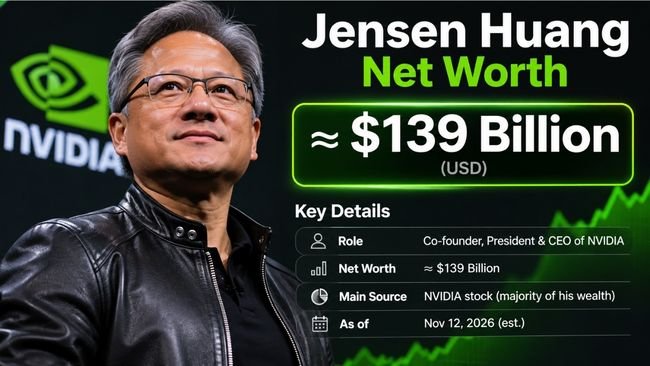
Jensen Huang, co-founder and CEO of Nvidia, is worth an estimated $154 billion to about $205 billion in 2026, depending on the date and the source. His fortune is almost entirely Nvidia stock, about 4% of the company, so it moves with every swing in the share price. Forbes had him at No. 7 on its November 1, 2026 list of the world’s richest people, behind Elon Musk, Jeff Bezos, Larry Page, Michael Dell, Sergey Brin and Mark Zuckerberg.
Few fortunes in modern business history have moved as fast as Huang’s. He was worth an estimated $77 billion in 2024. Two years later, depending on the week, he is worth two to three times that. The swings are not noise; they are the direct, almost mechanical result of owning a concentrated stake in one of the most important companies of the AI era.
How much is Jensen Huang worth in 2026?
There is no single figure. These are the readings found in reporting, each tied to a date.
| Date | Estimate | Source |
|---|---|---|
| Mar 2026 | $154 billion | Forbes list, as reported by DaveManuel |
| Apr 29, 2026 | $180.8 billion (No. 7) | Forbes real-time, via InvestorMint |
| May 14, 2026 | First above $200 billion | Forbes, via DaveManuel |
| Oct 2, 2026 | $204.5 billion | Forbes, via DaveManuel |
| Oct 21 to 22, 2026 | About $173.4 billion | Forbes profile, via DaveManuel |
| Nov 9, 2026 | $154.4 billion, after losing $7.8 billion in 24 hours | Nairametrics |
Bloomberg and other trackers were lower than Forbes earlier in the year: InvestorMint reported $160 billion to $166 billion in April 2026 against Forbes’ $180.8 billion for the same period. Different valuation dates, different share counts, and different treatment of vested restricted stock units explain most of the gap. None of these figures should be read as a bank statement; they are informed estimates built from public filings and daily share prices.
How much of Nvidia does Jensen Huang own?
Huang owns about 4% of Nvidia. Forbes’ profile implies roughly 866 million shares, close to the 870 million listed in Nvidia’s 2026 proxy statement. That stake did not come from a single windfall. Huang has held Nvidia equity since co-founding the company in 1993, and his ownership percentage has drifted down over three decades as the company issued new shares, split its stock multiple times, and diluted early holders to fund growth, pay employees, and complete acquisitions.
Nvidia became the first public company to reach a $5 trillion market value in October 2025, a threshold no other company had crossed. By October 22, 2026, with the stock closing near $212, the company was worth about $5.1 trillion. A four percent slice of a company that size is, almost by definition, one of the largest personal fortunes on the planet, and it will keep behaving that way for as long as Huang keeps the stake concentrated rather than diversifying into other assets.
How has his net worth grown?
| Year | Forbes estimate |
|---|---|
| 2024 | About $77 billion |
| 2025 | About $98.7 billion |
| 2026 | $154 billion to $205 billion, depending on the date |
The jump did not happen gradually. It tracked the market’s growing conviction that large language models and generative AI tools would require enormous amounts of specialized computing hardware, and that Nvidia’s graphics processors were, for the time being, the preferred way to build that hardware. As orders from cloud providers, AI labs, and governments piled up through 2024 and 2025, Nvidia’s revenue and profit expectations rose sharply, and its share price followed.
Why does his fortune swing so much?
Almost all of his wealth sits in one stock, which makes him unusually exposed to a single company’s fortunes compared with many other billionaires who have diversified across real estate, private equity, or multiple businesses. One commentator’s rule of thumb circulating in 2026 coverage put it simply: if Nvidia fell 30%, his net worth would fall roughly 29%, almost one for one. The November 9, 2026 drop of $7.8 billion in a single day shows the effect in practice. That was not a market crash; it was an ordinary bad trading day for a volatile stock, magnified by the sheer size of the position behind it.
This concentration cuts both ways. It is why Huang’s paper wealth climbed faster than almost anyone else’s during the AI buildout, and it is also why any slowdown in AI spending, any disappointing earnings call, or any shift in chip demand could knock tens of billions off his estimated net worth within days. Forbes and other trackers update their real-time estimates continuously for exactly this reason: a figure that is accurate on a Tuesday can be stale by Wednesday.
Where does he rank among the world’s richest?
Forbes put Huang at No. 7 on its November 1, 2026 list, behind Elon Musk, Jeff Bezos, Larry Page, Michael Dell, Sergey Brin, and Mark Zuckerberg. Musk led the list at $869 billion, a figure so large that it placed him more than four times ahead of Huang despite Huang’s own fortune running into the hundreds of billions.
What stands out about Huang’s position on these lists is how recent it is. A decade ago, Nvidia was a respected but far smaller company known mainly for gaming graphics cards, and Huang’s net worth, while substantial, was nowhere near the scale that would put him among the ten richest people alive. The AI boom changed that calculus within a few years, turning a company many investors had underestimated into one of the most valuable businesses in history and its co-founder into one of its wealthiest individuals.
What this means for readers
If you are trying to use Huang’s net worth as evidence of anything, the single most important fact is the date attached to the estimate. A headline from March 2026 and a headline from October 2026 can both be accurate and still differ by tens of billions of dollars, because Nvidia’s stock moved in between. Anyone comparing Huang’s wealth to another tech executive’s should check that both figures are from roughly the same window, since a few weeks’ gap can distort the comparison significantly given how volatile AI-linked stocks have been throughout 2026.
Frequently asked questions
What is Jensen Huang’s net worth? Estimates in 2026 range from about $154 billion to $205 billion. On November 9, 2026, one report put it at $154.4 billion after a one-day loss of $7.8 billion.
How much of Nvidia does he own? About 4%, or roughly 866 million shares by Forbes’ implied count, built up over more than three decades since he co-founded the company in 1993.
Is Jensen Huang a top-10 billionaire? Yes. Forbes ranked him No. 7 on its November 1, 2026 list.
Why do net worth figures for Huang differ so much? Forbes, Bloomberg, and other trackers price his shares on different dates and count shares and vested stock units differently. Because almost all of his wealth is in one volatile stock, even a gap of a few days between two estimates can produce a difference of tens of billions of dollars.
What is Nvidia worth? About $5.1 trillion on October 22, 2026. It first passed $5 trillion in October 2025, the first public company ever to do so.
Has Jensen Huang sold much Nvidia stock? Public reporting referenced here does not detail large personal sales; his wealth estimate is based primarily on his existing holdings rather than cash proceeds from selling shares.
Could his net worth keep rising? It is tied entirely to Nvidia’s share price and the broader market’s confidence in continued AI infrastructure spending. Either a strong earnings run or a pullback in that spending would move his estimated wealth significantly in either direction.
Sources
- Forbes: The top 10 richest people in the world (November 2026)
- DaveManuel: Jensen Huang net worth tracker
- Nairametrics: Huang loses $7.8 billion in 24 hours (Nov 9, 2026)
- InvestorMint: Jensen Huang net worth 2026
- Outlook Business: Nvidia hits $5 trillion
- Social Life Magazine: Huang net worth 2026
Net worth figures are third-party estimates, not financial advice.
