
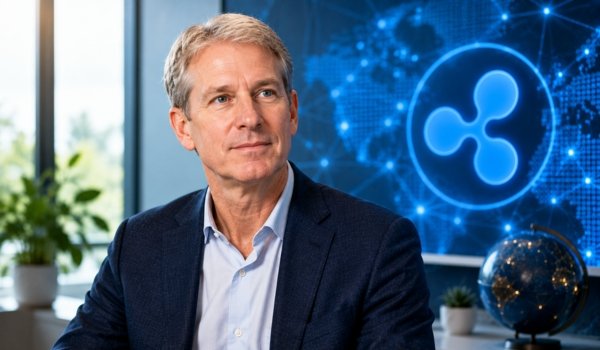
Chris Larsen is the co-founder and executive chairman of Ripple, the blockchain payment company behind XRP. Larsen is one of the most influential figures in cryptocurrency, known for his advocacy for financial inclusion and regulatory clarity in the digital asset space. His estimated net worth has reached as high as $37.3 billion during XRP’s 2018 peak.
Few names carry as much weight in the cryptocurrency world as Chris Larsen. Co-founder of Ripple and a longtime champion of digital payments, Larsen has spent decades pushing for a faster, fairer global financial system. His journey from Silicon Valley entrepreneur to one of the wealthiest people on the planet is both fascinating and instructive—a story about timing, vision, and the courage to challenge the status quo.
This article takes a deep dive into who Chris Larsen is, what he built, how his wealth was amassed, what controversies have followed him, and why his ongoing work continues to shape the future of cross-border payments. Whether you’re new to XRP or following Ripple’s legal battles closely, understanding Chris Larsen is key to understanding one of the most debated companies in the crypto space.
Who Is Chris Larsen and What Is His Background?
Christopher “Chris” Larsen was born in 1960 in San Francisco, California. He earned his undergraduate degree from San Francisco State University and later completed his MBA at Stanford Graduate School of Business—a credential that would open doors to Silicon Valley’s most exclusive circles.
Before he ever touched the world of crypto, Larsen was already making waves in financial technology. In 1996, he co-founded E-Loan, one of the first online mortgage lending platforms in the United States. At a time when most people still walked into banks to apply for loans, E-Loan digitized the entire borrowing process—a radical idea for its era. E-Loan was eventually acquired by Banco Popular in 2005 for approximately $300 million.
Larsen then co-founded Prosper Marketplace in 2005, one of America’s first peer-to-peer lending platforms. Prosper allowed individuals to borrow and lend money directly, bypassing traditional banks. It was another sign that Larsen’s instincts consistently pointed toward dismantling financial gatekeepers. By the time he pivoted to blockchain technology, he already had two fintech companies under his belt and a crystal-clear worldview: access to efficient, affordable financial services should not be a privilege.
How Did Chris Larsen Co-Found Ripple and What Was His Vision for XRP?
In 2012, Chris Larsen co-founded OpenCoin, which was later rebranded as Ripple Labs and then simply Ripple. He served as CEO until 2016, and has since held the role of executive chairman. Ripple was built on a specific thesis: the international money transfer system was broken, slow, and unnecessarily expensive, and blockchain technology could fix it.
At the heart of Ripple’s ecosystem is XRP, a digital asset designed for fast, low-cost cross-border transactions. Unlike Bitcoin, which operates as a decentralized peer-to-peer currency, XRP was designed primarily to serve as a bridge currency between different fiat currencies in financial transactions. A bank in Japan, for example, could convert yen into XRP, send it anywhere in the world in seconds, and have it converted into the recipient’s local currency—all for a fraction of a cent.
Larsen has consistently described this vision in terms of financial inclusion. According to the World Bank, approximately 1.4 billion adults globally remain unbanked as of 2021. Larsen sees Ripple and XRP as tools to bring those people into the financial system by reducing the barriers associated with traditional banking infrastructure. This mission has driven Ripple’s partnerships with hundreds of financial institutions and payment providers worldwide.
How Did Chris Larsen Accumulate His Wealth and How Much Is He Worth?
Chris Larsen’s wealth is almost entirely tied to his holdings in XRP. According to Forbes, at XRP’s peak price of roughly $3.84 in January 2018, Larsen’s net worth was estimated at $37.3 billion, briefly making him one of the five wealthiest people in the world. That figure has fluctuated dramatically since then, given XRP’s volatile price history.
Larsen reportedly holds billions of XRP tokens, a share he received as part of Ripple’s founding allocation. It’s worth noting that Ripple itself controls a significant portion of the total XRP supply, which critics have pointed to as a centralization concern—a charge that Larsen and Ripple have consistently pushed back against.
Beyond his XRP holdings, Larsen has invested in a range of technology and climate-focused ventures. He has publicly advocated for crypto mining reform, particularly around Bitcoin’s energy consumption, and donated to campaigns promoting the transition to more energy-efficient consensus mechanisms. In 2021, he helped fund an initiative called the Clean Energy Bitcoin Mining Initiative, which called on the Bitcoin community to move away from the proof-of-work algorithm.
What Has Been the Impact of the SEC Lawsuit on Chris Larsen and Ripple?
No discussion of Chris Larsen is complete without addressing the landmark legal battle between Ripple and the U.S. Securities and Exchange Commission (SEC). In December 2020, the SEC filed a lawsuit against Ripple Labs, Chris Larsen, and co-founder Brad Garlinghouse, alleging that XRP was an unregistered security and that over $1.3 billion had been raised through illegal securities offerings.
The lawsuit sent shockwaves through the crypto industry. Major exchanges, including Coinbase and Binance US, delisted XRP almost immediately following the announcement. XRP’s price dropped sharply. Larsen personally faced charges that he had sold approximately $450 million worth of XRP without proper registration.
The case became one of the most closely watched in crypto legal history. In July 2023, Judge Analisa Torres of the U.S. District Court for the Southern District of New York issued a partial ruling that XRP sold on public exchanges was not a security under U.S. law—a landmark decision that sent XRP’s price surging and was widely celebrated by crypto advocates. However, Judge Torres also ruled that XRP sold directly to institutional investors did constitute an unregistered securities offering.
The case underscored a broader debate about regulatory clarity in the United States and cemented Larsen’s role as one of the most prominent voices pushing back against what he and many others in the industry describe as “regulation by enforcement.”
What Role Does Chris Larsen Play in Advocating for Crypto Regulation?
Outside of Ripple’s day-to-day operations, Chris Larsen has become one of the most active political advocates in the crypto space. He has donated millions of dollars to political campaigns focused on establishing clear, functional crypto regulation in the United States and has spoken at numerous industry events about the need for a coherent federal framework.
Larsen’s position is nuanced. He doesn’t oppose regulation—he actively calls for it. His argument is that regulatory ambiguity is more damaging to innovation than clear rules, even strict ones. In multiple interviews and op-eds, he has pointed to countries like Japan, Singapore, and the United Kingdom as examples of jurisdictions that have created workable crypto frameworks that attract talent and investment without sacrificing consumer protection.
Larsen has also been vocal about what he sees as structural problems with the U.S. regulatory approach, arguing that the current environment pushes crypto companies and jobs overseas. He has testified before Congress, funded advocacy organizations, and partnered with other founders to lobby for legislation like the Lummis-Gillibrand Responsible Financial Innovation Act, which aims to create clearer rules for digital assets.
You can follow Ripple’s regulatory updates and legal developments directly on Ripple’s official newsroom to stay informed on the company’s latest positions.
What Does Chris Larsen Believe About the Future of Global Payments?
Larsen’s long-term vision extends beyond Ripple and XRP. He believes the global financial system is on the verge of a structural transformation—one in which open, interoperable payment networks replace the fragmented, legacy infrastructure currently used by banks and financial institutions.
In interviews, Larsen has described the current SWIFT-based system as a “fax machine in a smartphone world.” He envisions a future in which value moves across borders as easily as email—instantly, cheaply, and without intermediaries extracting fees at every step. Ripple’s On-Demand Liquidity (ODL) product, which uses XRP as a bridge asset, is the company’s attempt to make that vision commercially viable today.
Larsen has also spoken about the importance of interoperability between different blockchain networks. Rather than a single dominant chain, he sees a future with multiple coexisting ledgers that can communicate seamlessly—an idea gaining traction in the broader Web3 community. For readers interested in exploring Ripple’s payment infrastructure, Ripple’s solutions page provides a detailed breakdown of current products and use cases.
What Controversies and Criticisms Has Chris Larsen Faced Over the Years?
Chris Larsen is not without his critics. One of the most persistent criticisms leveled at him—and Ripple broadly—concerns the distribution of XRP. Because a large portion of XRP was pre-mined and distributed to Ripple’s founders and the company itself, detractors argue that XRP is fundamentally different from truly decentralized cryptocurrencies like Bitcoin or Ethereum. This concentration of supply, critics say, gives Ripple and its founders outsized influence over XRP’s market price and ecosystem.
Larsen has also faced scrutiny over his political donations, with some arguing that using crypto wealth to influence regulatory outcomes creates a conflict of interest. Others in the Bitcoin community have pushed back against his campaign to change Bitcoin’s consensus mechanism, arguing that proof-of-work is essential to Bitcoin’s security model and that Larsen’s advocacy is self-serving.
On the personal front, Larsen’s name appearing alongside Ripple’s in the SEC lawsuit—rather than just the company—drew significant attention to the fine line between a founder’s personal liability and corporate conduct. The fact that he ultimately was not found personally liable for the institutional sales aspect of the case was a significant legal outcome for him.
The Legacy Chris Larsen Is Building in the Digital Finance World
Chris Larsen occupies a rare space in technology history. He built transformative fintech companies before the term “fintech” existed, co-founded one of the most globally recognized blockchain companies, survived a years-long federal lawsuit, and emerged as a leading voice for crypto policy reform.
His story is not a simple triumphant arc. It’s marked by controversy, courtroom drama, billion-dollar swings in personal wealth, and a stubborn commitment to a vision of financial infrastructure that most of the world’s banks still resist. Whether you view him as a visionary or a disruptor, Larsen’s fingerprints are all over the modern conversation about what money should look like—and how it should move.
The debate around XRP, Ripple, and the broader future of digital payments is far from settled. But one thing is clear: as long as that debate continues, Chris Larsen will be at the center of it.
Frequently Asked Questions About Chris Larsen
Who is Chris Larsen in cryptocurrency?
Chris Larsen is the co-founder and executive chairman of Ripple, the blockchain payment company behind XRP. Larsen is one of the most prominent figures in crypto, known for co-founding three major fintech companies—E-Loan, Prosper Marketplace, and Ripple—and for his advocacy for crypto regulation reform.
What is Chris Larsen’s net worth?
Chris Larsen’s net worth peaked at approximately $37.3 billion in January 2018, according to Forbes, when XRP reached its all-time high. His wealth is primarily tied to his XRP holdings and has fluctuated significantly with the token’s price.
What was the outcome of the SEC lawsuit involving Chris Larsen?
In July 2023, a U.S. federal court ruled that XRP sold on public exchanges was not a security. However, the court also found that XRP sold directly to institutional investors constituted an unregistered securities offering. Larsen was personally named in the case but was not held personally liable for the programmatic sales.
Did Chris Larsen found any companies before Ripple?
Yes. Chris Larsen co-founded E-Loan in 1996, one of the first online mortgage platforms in the U.S., and Prosper Marketplace in 2005, one of America’s first peer-to-peer lending platforms. Both companies were pioneers in digital financial services well before crypto emerged as a mainstream topic.
What does Chris Larsen think about Bitcoin’s energy consumption?
Chris Larsen has been a vocal critic of Bitcoin’s proof-of-work mining model, citing its significant energy consumption. He co-funded the Clean Energy Bitcoin Mining Initiative in 2021, which called for Bitcoin to change its consensus mechanism to a more energy-efficient alternative—a campaign that drew significant pushback from the Bitcoin community.
