
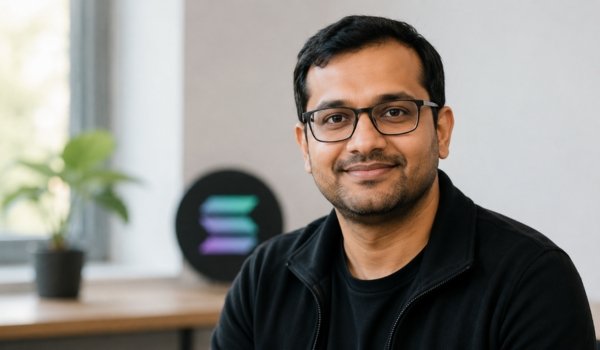
Sandeep Nailwal is an Indian entrepreneur and co-founder of Polygon (formerly Matic Network), one of the world’s leading Ethereum scaling platforms. Nailwal has been instrumental in making blockchain technology faster, cheaper, and more accessible to developers and everyday users worldwide, and is now a prominent philanthropist through the Crypto Relief initiative.
There are names in blockchain that most people recognize—Vitalik Buterin, Satoshi Nakamoto, Changpeng Zhao. Then there’s Sandeep Nailwal, a man who may not yet command the same pop-culture recognition, but whose contributions to the blockchain ecosystem are reshaping how millions of people interact with decentralized technology every day. As a co-founder of Polygon, Nailwal didn’t just build a product. He helped solve one of Ethereum’s most stubborn problems: scale.
Nailwal’s story is also something less common in the Web3 world—a story rooted not just in technical ambition, but in a deep sense of social responsibility. From raising hundreds of millions of dollars for COVID-19 relief in India to becoming a leading voice for ethical Web3 development, Nailwal sits at a rare intersection of entrepreneur, activist, and builder.
This article takes a deep look at who Sandeep Nailwal is, where he came from, what he built, and why his work matters—not just for crypto enthusiasts, but for anyone curious about the future of the internet.
Who Is Sandeep Nailwal? Understanding the Man Behind One of Crypto’s Most Important Projects
Sandeep Nailwal was born and raised in Uttarakhand, a northern state in India. His family background was modest, and access to elite education wasn’t guaranteed. Still, Nailwal pursued computer science and built a strong technical foundation early on. Before entering the crypto space, he worked in enterprise technology, gaining experience in software development and consulting—practical skills that would later prove critical when building blockchain infrastructure at scale.
He entered the cryptocurrency world around 2017, a period of extraordinary excitement and speculation in the industry. Rather than chase short-term gains, Nailwal focused on identifying structural problems within existing blockchain networks. That mindset led him to co-found Matic Network in 2017 alongside Jaynti Kanani and Anurag Arjun. The network was later rebranded as Polygon in 2021.
How Sandeep Nailwal Co-Founded Polygon and Why Ethereum’s Scaling Problem Created the Opportunity
To understand what Polygon does, you first have to understand Ethereum’s limitation. Ethereum, the world’s second-largest blockchain by market capitalization, is powerful—it supports smart contracts, decentralized applications (dApps), and an enormous developer ecosystem. But it’s slow and expensive when traffic spikes. During periods of high activity, gas fees (transaction costs) on Ethereum can rise to hundreds of dollars per transaction, effectively locking out ordinary users.
Polygon was built to solve this. Operating as a Layer 2 scaling solution, Polygon processes transactions off the main Ethereum chain, bundles them, and settles them on Ethereum in batches. The result? Transactions that cost fractions of a cent and settle in seconds—without sacrificing Ethereum’s security guarantees. According to Polygon’s official documentation, the network has processed billions of transactions and onboarded thousands of decentralized applications since its mainnet launch.
Nailwal served as the Chief Operating Officer during Polygon’s early years before transitioning to a co-founder and public-facing leadership role. His contribution went beyond operations—he became the network’s most vocal advocate, traveling globally to pitch Polygon to developers, enterprises, and governments alike.
For a deeper look at how Layer 2 solutions work and why they matter for blockchain’s future, this guide to Ethereum scaling from the Ethereum Foundation is an excellent starting point.

What Are Sandeep Nailwal’s Most Significant Contributions to the Blockchain Industry?
Nailwal’s fingerprints are on several of the most consequential moments in Polygon’s growth. When the network was still called Matic and barely known outside niche crypto circles, it was accepted into Binance Launchpad in 2019—one of the first major validations of the project. That listing helped generate early community momentum.
Under Nailwal’s influence, Polygon pursued an aggressive partnership and acquisition strategy in the early 2020s. The network acquired several zero-knowledge proof (ZK) companies, including Hermez Network, Mir Protocol, and Plonky2, investing hundreds of millions of dollars to build what Polygon calls the “ZK stack”—a suite of tools enabling fast, private, and scalable blockchain transactions.
Polygon’s partnerships with major brands further cemented its relevance beyond crypto. Starbucks, Reddit, Meta, and Disney have all explored or launched projects on Polygon. Reddit’s blockchain-based Community Points program, for instance, used Polygon to mint digital collectibles for millions of users. These are not fringe experiments—they are large-scale deployments that exposed mainstream audiences to blockchain technology, often without them realizing it.
Nailwal has consistently framed Polygon’s mission in terms of access. In numerous interviews, he has argued that blockchain only fulfills its promise when it becomes cheap and fast enough for everyday use. His focus on reducing barriers to entry—whether for developers building apps or users completing transactions—reflects a philosophy that decentralization must be practical, not just ideological.
How Did Sandeep Nailwal Launch Crypto Relief and Raise Hundreds of Millions for India’s COVID Crisis?
In May 2021, India was experiencing one of the worst COVID-19 surges in the world. Hospitals were overwhelmed, oxygen supplies were collapsing, and the official death toll was widely considered an undercount. Nailwal responded with urgency.
He launched Crypto Relief, a nonprofit initiative designed to accept cryptocurrency donations and deploy funds rapidly to COVID-19 relief efforts across India. The campaign quickly attracted global attention. Vitalik Buterin, the co-founder of Ethereum, donated approximately $1 billion worth of crypto tokens—including a significant amount of Shiba Inu tokens—to the fund. In total, Crypto Relief raised over $1 billion in cryptocurrency, becoming one of the largest crypto-based humanitarian fundraising efforts ever recorded.
The initiative wasn’t without complexity. Converting billions in volatile crypto assets to fiat currency, navigating Indian regulatory frameworks, and deploying funds efficiently through NGOs required logistical sophistication. Nailwal coordinated with local organizations, medical suppliers, and government entities to move quickly during a genuine humanitarian emergency.
Crypto Relief is now a permanent charitable organization with a broader mandate, focusing on causes that include rare disease research and global health initiatives. Nailwal has said publicly that philanthropy is not a side project for him—it is a core part of how he thinks about the role of wealth created through crypto.
For context on how crypto philanthropy is reshaping global giving, this overview of blockchain-based charitable giving from Giveth offers useful background.
What Does Sandeep Nailwal Believe About Web3’s Future and the Role of Regulation?
Nailwal is not an absolutist. Unlike some figures in the crypto space who view all regulation as an existential threat, he has consistently advocated for thoughtful regulatory frameworks that protect users without stifling innovation. In interviews and panel discussions, he has called on governments to collaborate with blockchain projects rather than default to prohibition.
He has also been vocal about the problem of bad actors in crypto—rug pulls, fraudulent token launches, and pump-and-dump schemes that harm retail investors and tarnish the broader ecosystem. Nailwal’s position is that the crypto industry must self-regulate more effectively if it wants to maintain credibility and attract mainstream adoption.
His public commentary on the collapse of FTX in 2022 exemplified this stance. While many in the space initially stayed quiet, Nailwal was among those who called for transparency, accountability, and structural reform in how centralized exchanges operate.
This willingness to criticize the industry from within gives Nailwal a different kind of credibility. He is not simply a promoter of everything crypto—he is someone who genuinely believes in the technology’s potential and therefore cares about protecting its reputation.
Why Sandeep Nailwal Remains One of the Most Influential Figures in Global Blockchain Development
Ranking influence in a decentralized space is inherently imperfect, but several metrics point to Nailwal’s outsized impact. Polygon has consistently ranked among the top blockchain networks by total value locked (TVL), active users, and developer activity. The network’s native token, MATIC (recently rebranded to POL), has maintained a position among the top cryptocurrencies globally by market capitalization for several years.
Beyond metrics, Nailwal’s influence is perhaps most visible in how he has shaped the conversation about what blockchain is for. By championing practical scalability, responsible philanthropy, and regulatory engagement, he has pushed Web3 discourse toward maturity. He represents a generation of blockchain entrepreneurs who came after the initial Bitcoin idealists and the Ethereum experimenters—a generation focused on building systems that actually work for real users.
His public profile continues to grow. Nailwal appears regularly at global technology and finance conferences, contributes to policy discussions, and mentors early-stage blockchain founders through various initiatives. Polygon’s ecosystem fund, which supports developers building on the network, is one of the most active grant programs in the Web3 space.
For developers and entrepreneurs interested in building on Polygon’s infrastructure, the official Polygon developer documentation provides a comprehensive technical starting point.
What Comes Next: Sandeep Nailwal’s Vision for a Scalable and Equitable Web3
Nailwal has made clear that zero-knowledge technology is where Polygon—and his own focus—is headed. ZK proofs allow blockchains to verify transactions with cryptographic certainty while revealing minimal information, enabling both privacy and scalability simultaneously. Polygon’s investment in ZK technology represents a long-term bet that this approach will underpin the next major phase of blockchain infrastructure.
He has also spoken about the importance of bringing the next billion users into Web3 through applications that don’t require users to understand blockchain at all. Invisible blockchain—where the technology runs silently beneath consumer apps—is, in his view, how mass adoption actually happens.
The tension between decentralization and usability remains one of the central challenges in the industry. Nailwal’s approach is pragmatic: build for usability now, preserve decentralization where it counts, and expand both over time as the technology matures.
The Lasting Significance of Sandeep Nailwal’s Work in Crypto and Beyond
Sandeep Nailwal’s career arc—from enterprise software developer in India to co-founder of one of the world’s most important blockchain networks—is a story about identifying real problems and building real solutions. Polygon didn’t succeed because of hype alone. It succeeded because it addressed a genuine bottleneck in Ethereum’s infrastructure and did so with enough engineering quality and business execution to attract serious adoption.
The philanthropic dimension of his work adds another layer of significance. Crypto Relief demonstrated that decentralized financial infrastructure can mobilize resources at humanitarian scale with remarkable speed—a proof of concept that has implications far beyond India.
Nailwal remains a builder, a critic, and an advocate—often simultaneously. That combination is rare in any industry, and rarer still in one as fast-moving and ideologically charged as blockchain. Watching where he takes Polygon next, and what he builds beyond it, is one of the more compelling storylines in global technology right now.
Frequently Asked Questions About Sandeep Nailwal and His Work in Blockchain
Who is Sandeep Nailwal and what is he known for?
Sandeep Nailwal is an Indian entrepreneur best known as the co-founder of Polygon (formerly Matic Network), a leading Ethereum scaling solution. He is also known for founding Crypto Relief, a nonprofit initiative that raised over $1 billion in cryptocurrency for COVID-19 relief in India in 2021.
What did Sandeep Nailwal build with Polygon?
Nailwal co-built Polygon as a Layer 2 scaling platform for Ethereum, enabling faster and cheaper transactions. Since launch, Polygon has processed billions of transactions and partnered with major brands including Starbucks, Meta, and Reddit.
What is Crypto Relief and how did Sandeep Nailwal start it?
Crypto Relief is a charitable organization founded by Nailwal in May 2021 in response to India’s devastating second COVID-19 wave. The initiative accepted cryptocurrency donations, received a landmark contribution from Ethereum co-founder Vitalik Buterin, and raised over $1 billion to support medical relief efforts across India.
What is Sandeep Nailwal’s position on crypto regulation?
Nailwal supports thoughtful regulation that protects users and builds public trust in blockchain technology. He has called for collaboration between governments and blockchain projects, and has publicly criticized fraudulent practices within the crypto industry.
What is Polygon’s ZK technology strategy and why does Nailwal prioritize it?
Polygon has invested heavily in zero-knowledge proof technology, acquiring multiple ZK-focused companies. Nailwal views ZK proofs as the foundation for blockchain’s next phase because they enable both scalability and privacy, which are essential for mainstream enterprise and consumer adoption.
