
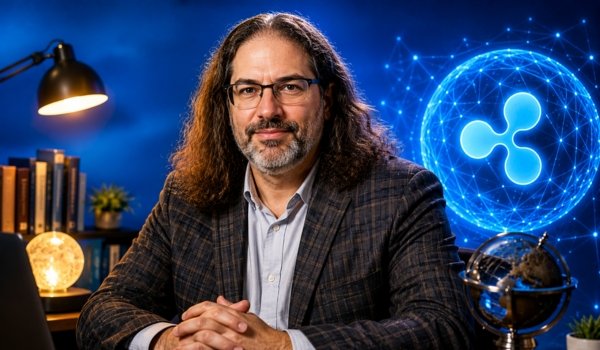
David Schwartz is the Chief Technology Officer of Ripple and one of the original architects of the XRP Ledger. A self-taught cryptographer and software engineer, Schwartz has shaped Ripple’s technology from its earliest days and remains one of the most influential—and approachable—voices in the cryptocurrency industry.
There are names in crypto that command immediate recognition: Satoshi Nakamoto, Vitalik Buterin, Charles Hoskinson. But David Schwartz occupies a different kind of space. He’s not a headline-chaser or a conference keynote fixture. He’s a builder—the kind who spends decades solving problems most people don’t even know exist. And yet, his fingerprints are all over one of the most widely adopted blockchain networks on the planet.
Schwartz helped design the XRP Ledger before most people had heard the word “blockchain.” He has guided Ripple’s technology through legal battles, market crashes, and industry pivots. He communicates openly with the XRP community on social media, often explaining deeply technical concepts in plain English with a dry wit that’s earned him a loyal following. Understanding who David Schwartz is means understanding how Ripple became what it is today.
This article traces his career, his technical contributions, and his ongoing role in shaping the future of digital payments and decentralized finance.
Who Is David Schwartz, and How Did He Get Into Cryptography Before It Was Cool?
David Schwartz wasn’t handed a computer science degree and a Silicon Valley internship. He’s largely self-taught, which may explain why his approach to problem-solving tends to be unconventional. Before joining what would become Ripple, Schwartz built software for the NSA (National Security Agency) and worked extensively in encrypted communications—experience that would later prove invaluable when designing the security architecture of the XRP Ledger.
His interest in digital currency and cryptographic systems predates Bitcoin. In a 2018 interview, Schwartz revealed that he had thought about building a decentralized digital currency as far back as the early 1990s, citing concerns about the technical and regulatory obstacles that made it seem impossible at the time. When Bitcoin emerged in 2009, it was proof that those obstacles could be overcome. For Schwartz, it was less a revelation and more a confirmation.
He joined OpenCoin—the company that later became Ripple Labs—in 2011, shortly after its founding. His title was Chief Cryptographer, and he worked alongside co-founders Jed McCaleb and Chris Larsen to develop a consensus-based ledger that could move value faster and more efficiently than Bitcoin.
How Did David Schwartz Help Build the XRP Ledger, and What Makes It Different From Other Blockchains?
The XRP Ledger is not a blockchain in the traditional sense. Unlike Bitcoin, which uses proof-of-work mining to validate transactions, the XRP Ledger relies on a consensus protocol—a mechanism where a network of trusted validators agrees on the state of the ledger without competing to solve cryptographic puzzles. Schwartz was instrumental in designing this approach.
The practical implications are significant. Transactions on the XRP Ledger settle in three to five seconds. The network processes up to 1,500 transactions per second. There are no mining fees, and the energy consumption is a fraction of what Bitcoin or Ethereum require. These weren’t accidental outcomes—they were design choices made by Schwartz and his collaborators to build a payment network that could realistically compete with SWIFT and traditional correspondent banking.
Schwartz has consistently defended the XRP Ledger’s consensus model against criticism, particularly claims that it is too centralized. He argues that the validator structure—which allows anyone to run a validator and choose which validators they trust—is more decentralized in practice than proof-of-work systems, where mining power is concentrated among a small number of large mining pools. Whether you agree with that assessment or not, it reflects the kind of principled, evidence-based thinking that defines Schwartz’s approach to technical debate.
For a deeper breakdown of how the XRP Ledger’s consensus mechanism works, Ripple’s official documentation is one of the most thorough publicly available explanations of the protocol.
What Is David Schwartz’s Role as CTO of Ripple and How Has It Evolved Over Time?
Schwartz was appointed Chief Technology Officer of Ripple in 2018, succeeding Stefan Thomas. By that point, he had already been the de facto technical lead for years, having shaped both the architecture of the XRP Ledger and the broader product direction of Ripple’s enterprise payment solutions.
As CTO, Schwartz oversees Ripple’s engineering and product teams, guides the technical roadmap, and serves as the primary public voice on matters of protocol design and blockchain infrastructure. He’s also deeply involved in Ripple’s regulatory engagement, often explaining the technical nuances of the XRP Ledger to policymakers and journalists who may lack a background in cryptography.
His tenure as CTO has coincided with some of Ripple’s most turbulent years. The SEC lawsuit, filed in December 2020, alleged that Ripple had sold XRP as an unregistered security. The case drew intense scrutiny to Ripple’s operations and put pressure on the entire XRP ecosystem. Throughout the legal proceedings, Schwartz remained publicly engaged, offering commentary on the case’s developments and maintaining transparency with the community to the extent that legal constraints allowed.
In July 2023, Judge Analisa Torres issued a partial ruling that XRP sold on public exchanges did not constitute a security—a landmark decision that was widely seen as a significant win for Ripple and the broader crypto industry. Schwartz called it a “great day” for the XRP community.
How Does David Schwartz Communicate With the XRP Community, and Why Does It Matter?
One of the defining characteristics of Schwartz’s public persona is his accessibility. On X (formerly Twitter), where he goes by the handle @JoelKatz, he regularly engages with developers, investors, and critics. He answers technical questions, pushes back on misinformation, and occasionally shares his views on topics well outside cryptocurrency—from philosophy to parenting. His tone is measured but not timid, and he’s willing to say “I don’t know” when he doesn’t.
This directness is uncommon at the executive level, particularly in an industry as volatile and speculative as crypto. It has earned Schwartz a reputation as one of the more trustworthy figures in the space—someone whose statements carry weight precisely because he doesn’t traffic in hype.
His communication style has also been a strategic asset for Ripple. During periods of market turbulence or regulatory uncertainty, Schwartz’s calm, technically grounded commentary has helped stabilize community sentiment. He doesn’t make price predictions. He doesn’t promise timelines he can’t keep. He explains what the technology does, what it doesn’t do, and what the team is working on.
For anyone following developments in the XRP ecosystem, Schwartz’s X profile remains one of the most reliable primary sources available.
What Are David Schwartz’s Views on Decentralized Finance and the Future of Digital Payments?
Schwartz has spoken at length about the potential for blockchain technology to transform global payments—but he’s also been candid about the limitations of current DeFi infrastructure. He sees the XRP Ledger’s built-in decentralized exchange and its support for the Automated Market Maker (AMM) functionality as steps toward a more open financial system, but he doesn’t claim that decentralization is a panacea.
In multiple public interviews, Schwartz has argued that the most transformative use case for blockchain isn’t speculative trading—it’s cross-border value transfer. He points to the inefficiency of correspondent banking, where a single international wire transfer may pass through three or four intermediary banks, each taking a fee and adding latency. Ripple’s payment network, which uses XRP as a bridge currency, is designed to collapse that process into seconds.
He’s also been thoughtful about the role of central bank digital currencies (CBDCs), noting that they could either complement or compete with networks like the XRP Ledger depending on how they’re designed and regulated. Schwartz doesn’t treat CBDCs as an existential threat—he sees them as evidence that governments are increasingly convinced that digital-native money is the future.
What Can Developers and Builders Learn From David Schwartz’s Approach to Engineering?
Schwartz’s career offers a few lessons that extend well beyond the XRP Ledger. The first is the value of first-principles thinking. Rather than adapting existing systems, Schwartz and his collaborators asked what properties a global payment network actually needed—speed, low cost, finality, energy efficiency—and designed backward from those requirements. The result was a system that looked nothing like Bitcoin, which was already generating enormous excitement at the time.
The second lesson is intellectual honesty. Schwartz is genuinely willing to acknowledge the tradeoffs in the XRP Ledger’s design. The consensus model sacrifices some of the theoretical decentralization of proof-of-work for dramatically better performance. He doesn’t hide that tradeoff—he explains it and defends the reasoning. That kind of transparency builds credibility that marketing copy never could.
The third lesson is long-term commitment. Schwartz has been working on the XRP Ledger for well over a decade. He’s seen the project through periods of euphoric optimism and existential legal peril. His continued presence at Ripple is itself a signal—one that the community reads carefully.
Frequently Asked Questions About David Schwartz
Who is David Schwartz in the context of Ripple and XRP?
David Schwartz is the Chief Technology Officer of Ripple and one of the three original architects of the XRP Ledger, alongside Jed McCaleb and Arthur Britto. He joined the company in 2011 and has overseen the technical development of the XRP Ledger ever since.
What is David Schwartz’s background before Ripple?
Schwartz is largely self-taught in cryptography and software engineering. Before joining Ripple, he built encrypted communication software for government clients, including work associated with the NSA. He has cited an interest in digital currency dating back to the early 1990s.
Why does David Schwartz go by “JoelKatz” on social media?
Schwartz has used the handle @JoelKatz online for many years, predating his work at Ripple. It has become closely associated with his identity in the XRP community, and he has continued using it as his public-facing handle on X.
What role did David Schwartz play in Ripple’s SEC lawsuit?
As CTO, Schwartz remained publicly engaged throughout the SEC lawsuit, which began in December 2020. While he was constrained in what he could discuss for legal reasons, he regularly communicated with the XRP community and provided context on technical and regulatory developments as they unfolded.
What does David Schwartz believe about the future of crypto and digital payments?
Schwartz believes that the most transformative application of blockchain technology is cross-border payments. He argues that decentralized ledgers can dramatically reduce the cost and latency of international money transfers, and sees the XRP Ledger’s design as purpose-built for that use case.
Is David Schwartz still at Ripple?
As of the time of publication, David Schwartz continues to serve as Chief Technology Officer at Ripple, where he oversees engineering, product development, and the ongoing evolution of the XRP Ledger.
David Schwartz’s Legacy and What It Tells Us About Building for the Long Game
It’s easy to celebrate the loudest voices in any industry. Crypto, in particular, has never lacked for charismatic promoters willing to make bold predictions and court controversy. David Schwartz has never been that person. He’s been something rarer: a technically rigorous, communicatively honest, long-tenured builder who has kept his head down through cycles of boom, bust, and legal uncertainty.
The XRP Ledger he helped design now underlies a global payment network used by financial institutions across more than 55 countries. That didn’t happen by accident. It happened because someone—or rather, a small team, with Schwartz at its technical core—made a series of principled decisions about what mattered most and stuck to them for over a decade.
For those tracking Ripple’s evolving roadmap, including its recent expansions into tokenization, CBDCs, and DeFi infrastructure, Ripple’s official blog offers regular updates directly from the company’s leadership and engineering teams.
Schwartz’s story isn’t finished. The XRP Ledger continues to evolve, the regulatory landscape is still settling, and the ambition to reshape global payments remains very much alive. Whatever comes next, the technical foundation he helped lay will be central to it.
